The 21 Stations
One drama in twenty-one beats — from the Beginning to the Eschaton. Each station: a question, an image, a piece of music, and a reading.
← back to the arcThe Beginning
idol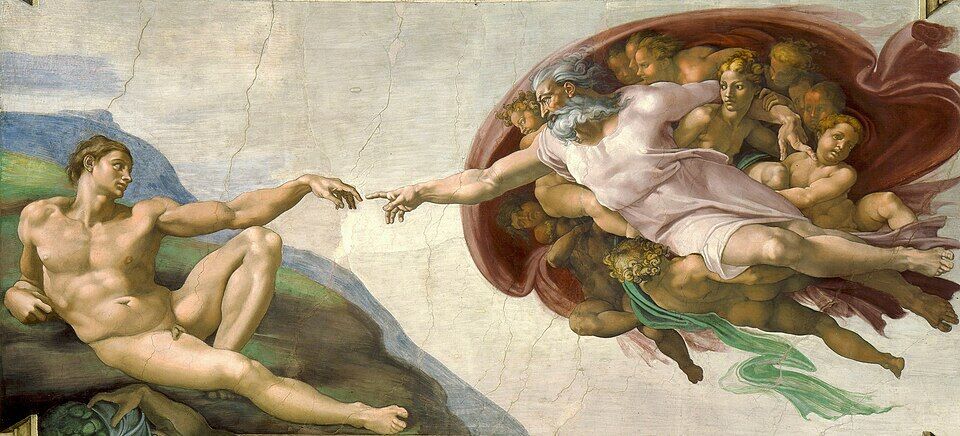
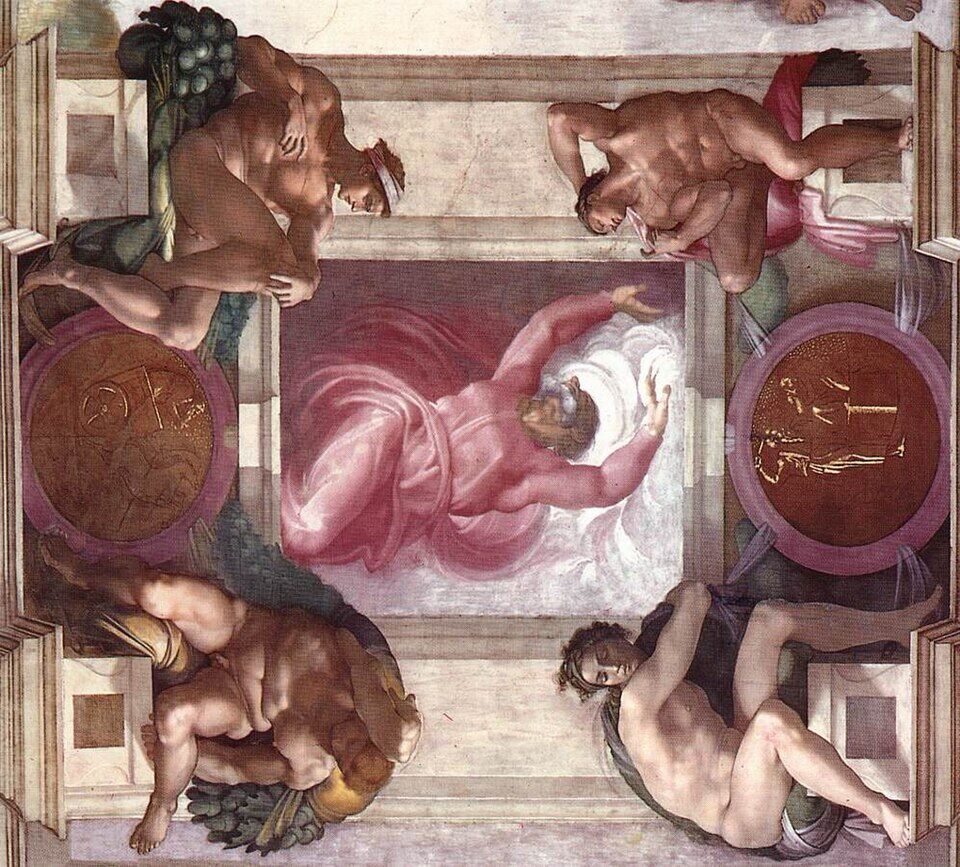
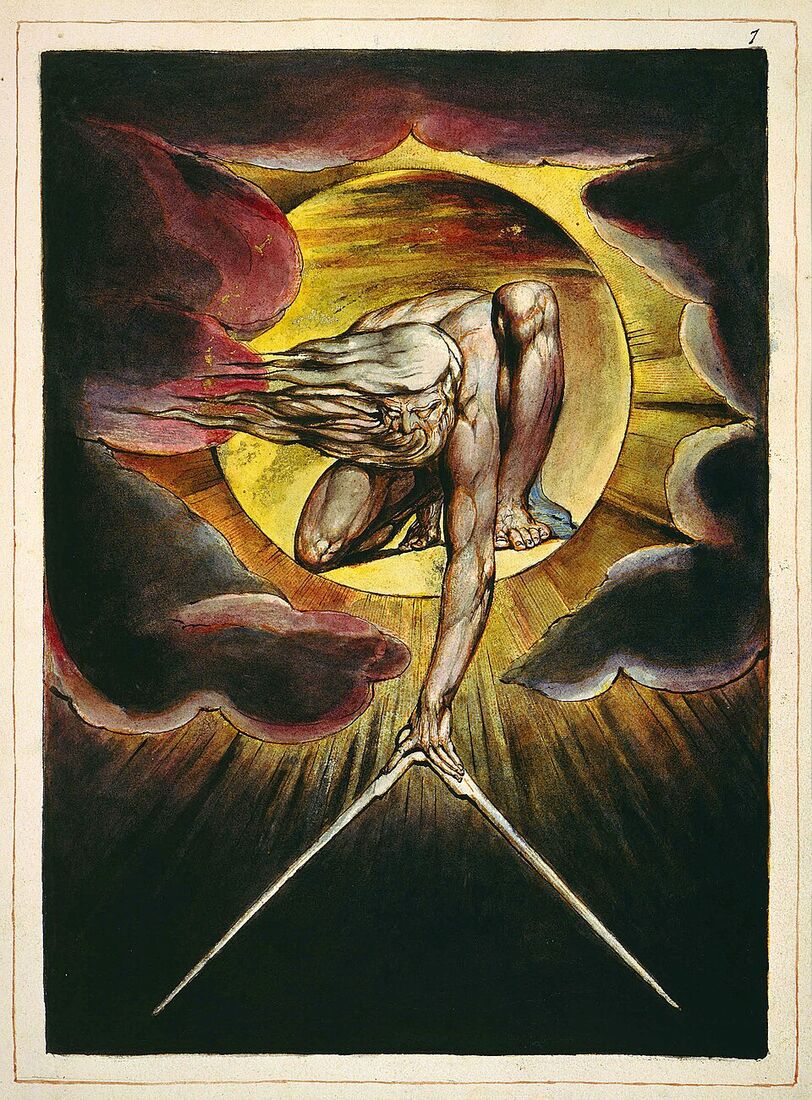
Imagine silence — impenetrable, dense, velvet darkness, in which there is as yet no "before" and no "after," no "here" and no "there." There is only God, beyond time and space, infinite and eternal — and nothing else. And in this silence sounds "let there be." God creates the world — but how? Not as a craftsman turns a table: the craftsman has wood, but from what does one create when as yet there is nothing? And not as one begets a child in one's own likeness — otherwise the world would be a second god, whereas God is one. The Bible names a third, unprecedented way: creation out of nothing. The world is not a part of God nor His double, but the expression of His love, to which freedom is given. And on each day of creation it is said, "and this is good" — the perfect Craftsman makes nothing ugly, and the world comes forth from His hands as a gift: beautiful and under no obligation to be. Last of all man is created — and he is created twice. His body is taken from the dust, as with every beast: here he is no higher than the frog and the blade of grass. But God bends down to the vessel of clay and breathes into it His own breath of life. What is this breath? It is freedom. The frog cannot desire to fly, the cow does not choose whether to be a cow — but man is free to say "yes" to God and free to say "no," free even from the Creator Himself. This is what "in the image and likeness" means: not the face nor the reason in themselves, but that pre-worldly freedom of which Berdyaev will write — "in the very depth of my destiny." This is not a command but an invitation to love: for only he loves who is free not to love. And from this freedom is born the second thing — creativity. God the Creator makes man a small creator: He brings him into a world made ready and bids him have dominion, to name the beasts — and to name is to take into one's own hands. The whole beautiful world God gives over to man, as a father gives to his son. Man is not God by nature — he is God by grace, by gift: the divine in him is not his own but breathed in. And here, at the very summit, hides the risk. That same freedom by which one cannot love under compulsion is capable of saying "no." The breath that made man the image of God also makes the catastrophe possible — and it will come not as a stone that breaks loose from a mountain, but as a choice: man will turn his will to evil. Of this — the next station.
The Fall
collapse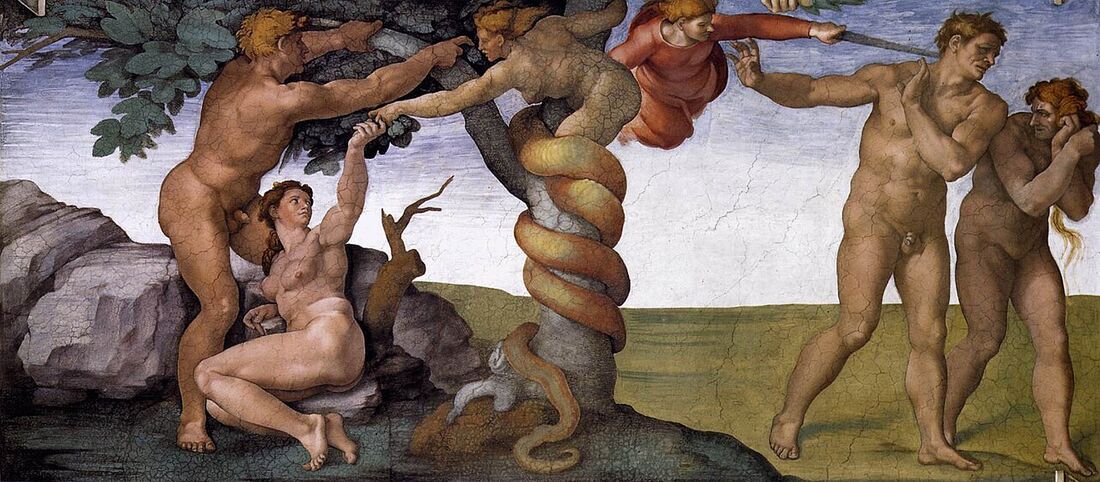
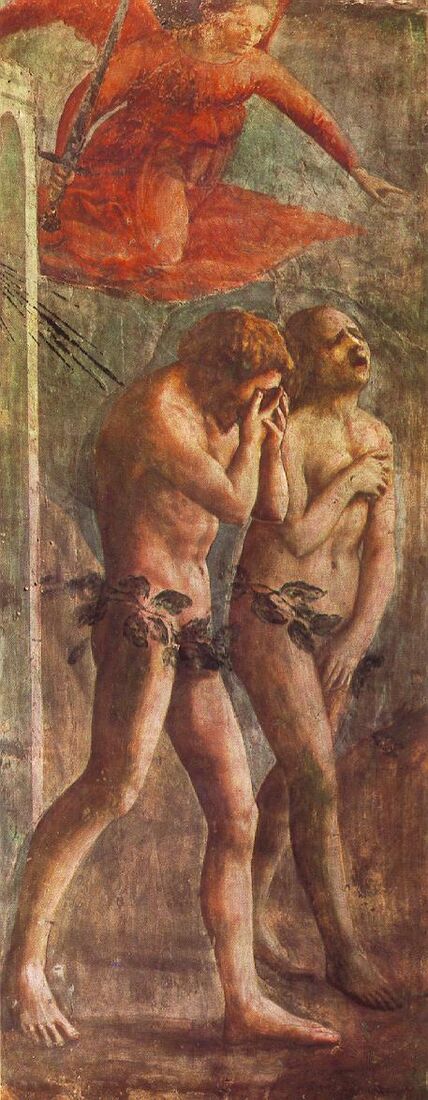
The Garden of Eden is a state of perfect trust. There is no shame, no fear: man and woman are still one whole, each the continuation of the other, and both are naked and are not ashamed. God walks with man in the cool of the day. But the serpent appears — and this is no crawling snake but the most ancient cosmic evil, freedom fallen away, existing before man. He offers the apple — he offers doubt. “Hath God really said?” He offers freedom from God — and does not even lie about death: “ye shall not die bodily, ye shall be as gods, knowing good and evil.” He is right in a terrible sense: it is not the body that will die, but being itself, for God is being, and separation from Him is a passage into nonbeing. And man makes the first tragic choice. But let us look closely at the motive: the fruit is “pleasant to the eyes, to be desired, good for food” — this is a desire for oneself. God creates by giving; here, for the first time, man wants to take — to live not for another but for himself. And so the first thing they come to know, having known evil, is shame: not shame of the body, but the fear that another will use you, that the other is no longer kin to you but a danger. A rupture. A wall. Paradise slams shut not by God’s will, but because man, having come to know shame, can no longer bear His gaze — and hides. And when God calls, “Adam, where art thou?” man answers by shifting the blame: “the woman whom Thou gavest me.” Everyone is guilty, I least of all — the formula by which all of history will live. And now God, whose heart is broken, asks the first question that will sound as the leitmotif of all history: what, then, is to be done? To destroy the creation — or to find a way back without breaking their freedom?
The Promise
return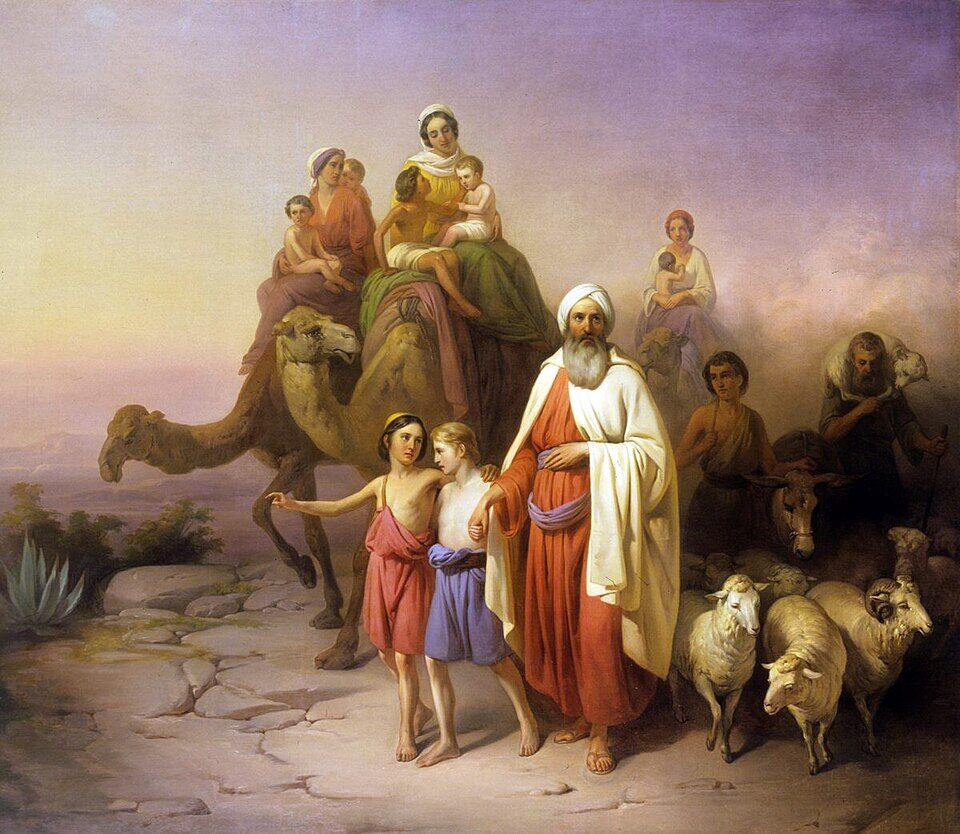
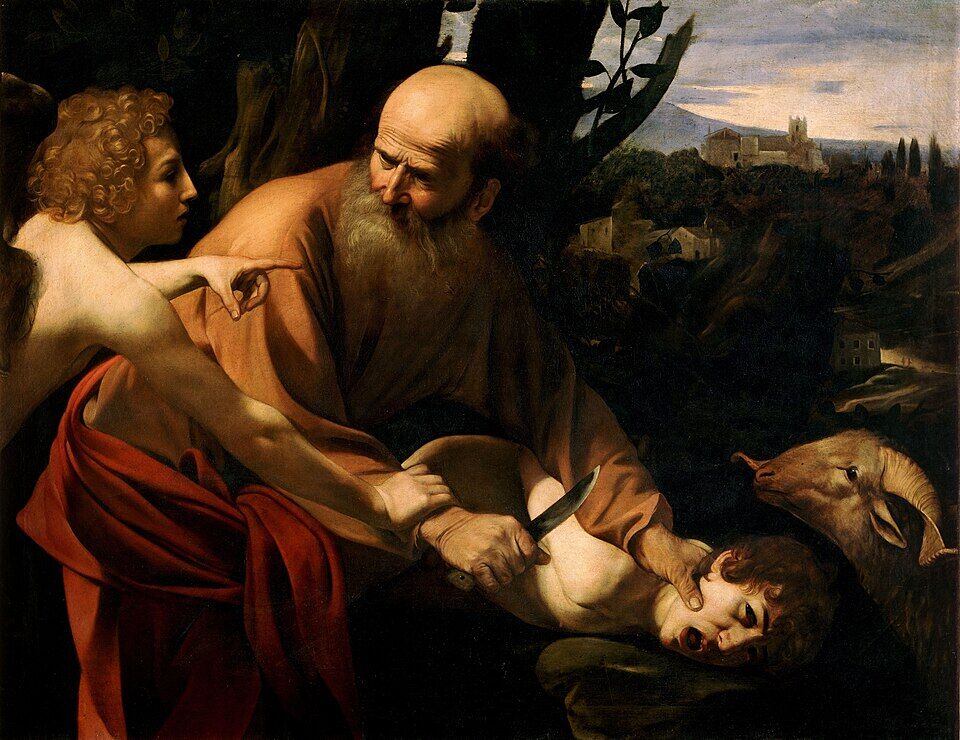
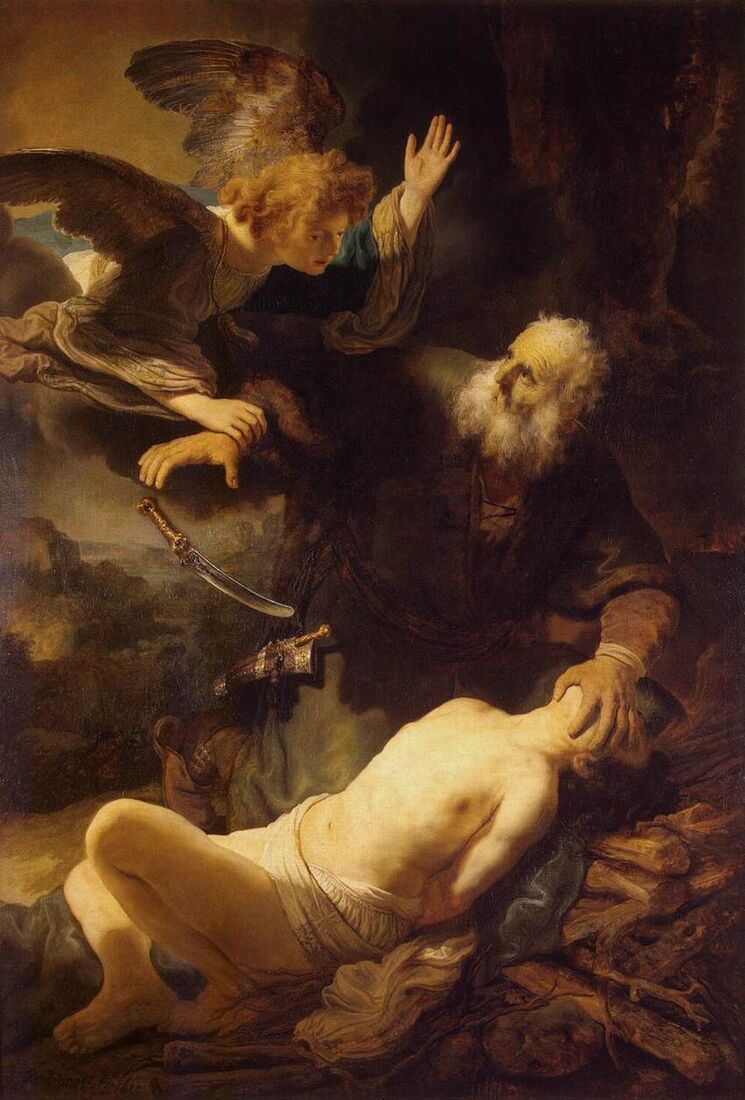
The search begins not with a king and not with a philosopher, but with a single old man. Abraham is neither a Jew nor a righteous man from birth: a wealthy Amorite cattle-herder from Ur, an aristocrat, a “prince of God,” a man settled and deeply rooted. And then a voice sounds to him: “Go out from your land, from your kindred, and from your father’s house, into the land that I will show you.” Today it is hard to hear what an abyss this was. In the ancient world, to leave one’s city meant to lose everything at once: the protection of the city walls; the vengeance of the clan, which alone stood up for its own; the laws under which you were a human being and not prey; and even one’s own gods, bound to that land. Exile was the second-heaviest punishment after the death penalty. God calls Abraham to become a voluntary exile — a “wretched sojourner” among strangers, without rights, without guarantees, without a road back. And all of this in return not for a map or a treaty, but only for a voice and a promise that cannot be verified. Abraham’s faith is the first ray of light in the pitch dark of self-will: not certainty, but risk — trust in One whose face you have not seen, on terms you do not know. Abraham departs — and never returns; grown old, he does not even carry the body of his dead wife back to his homeland, but buys a stranger’s cave to lie in a foreign land forever. From this step the very word “Hebrew” is born — “ibri,” “the one who crossed the river”: not a name of blood, but a name of wandering, of restlessness for God’s sake. And when the risk seems tested to the very end, yet another abyss opens — Mount Moriah. God demands as a sacrifice Isaac, the son of the promise, for whose sake the whole thing had been undertaken. Abraham raises the knife, passes through the hellish pain of obedience — and at the last instant the hand of God stops him. Here the entire ancient world of bloody sacrifices collapses: it is revealed that God does not need human sacrifices — He needs hearts. To Abraham it was given to learn the very thing for which it was worth going out from Ur: that one can trust God to the very end, because there is no one more faithful than He. This one old man who trusted will become the channel through which the promise flows down to a people, to the ages, to us. Of this — the next station.
The Exodus
return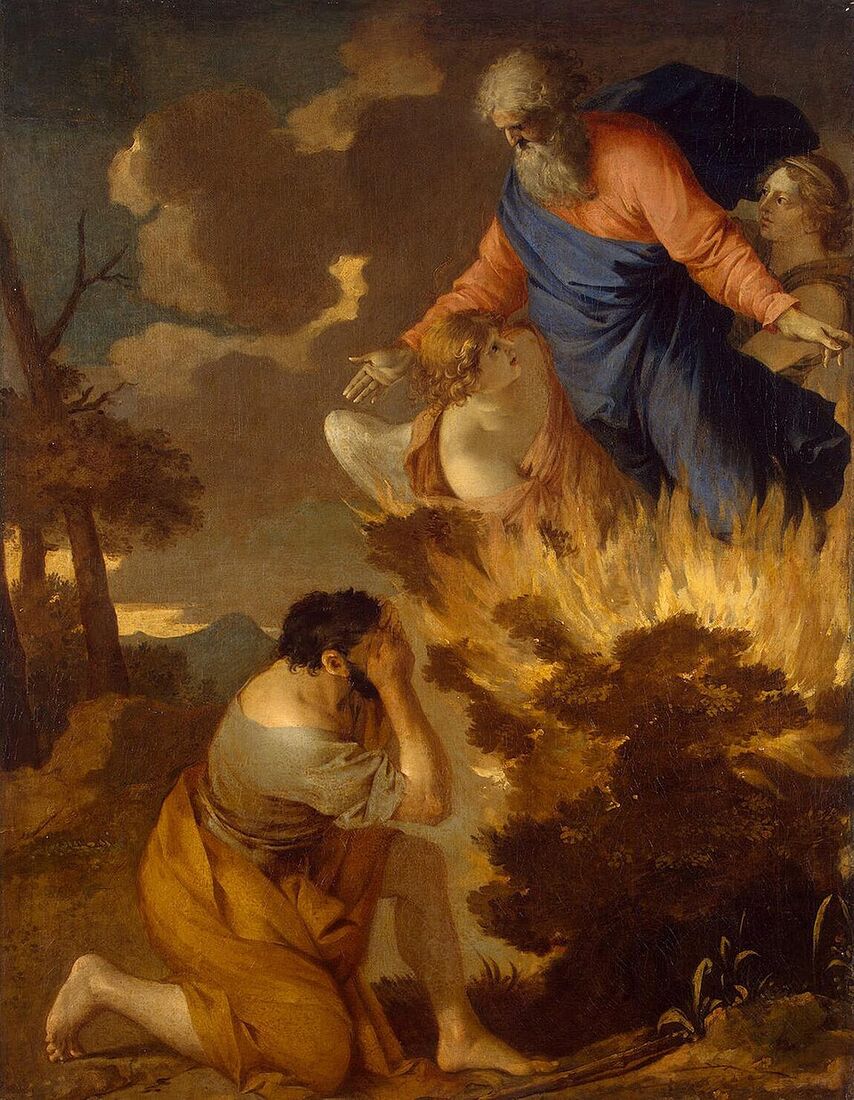
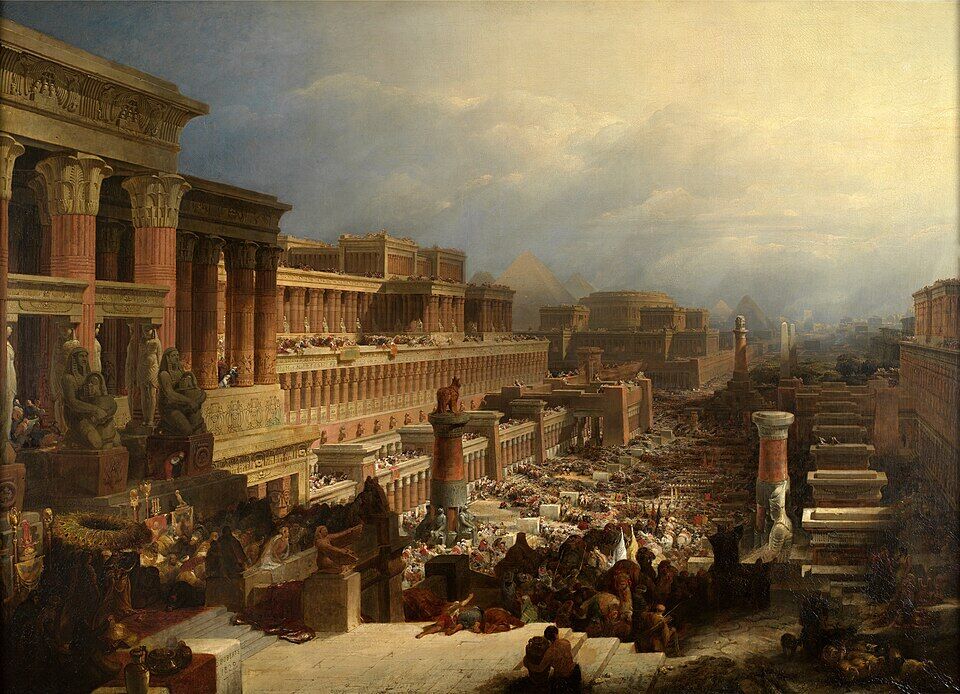
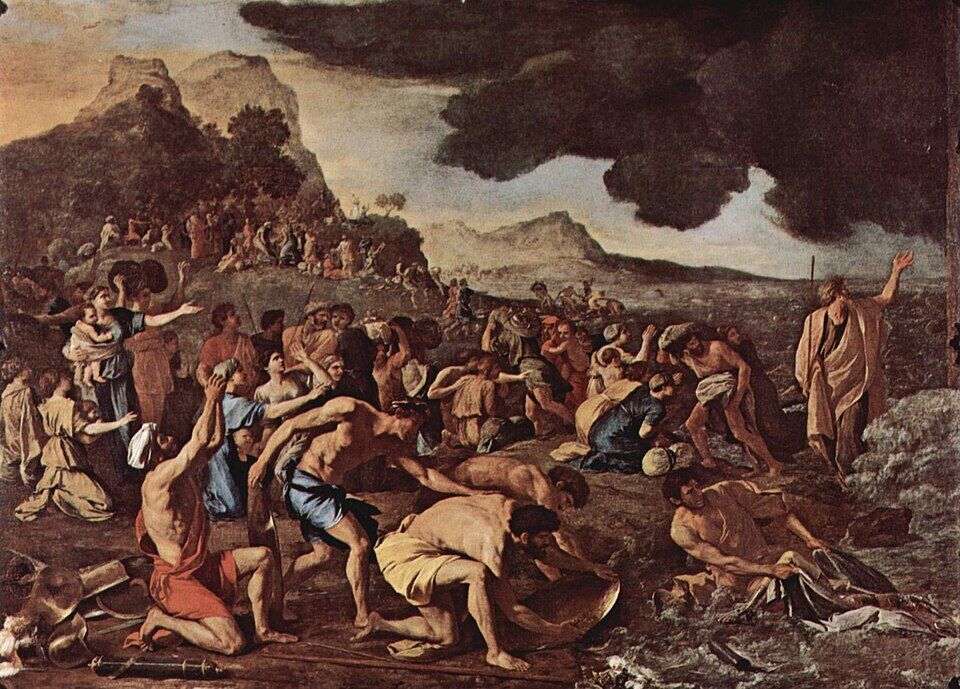
A people forgets faster than it remembers. A few generations pass, and the descendants of the free patriarchs—those who trusted the voice and walked out into the unknown—become slaves in Egypt. The one who comes to free them is one of their own: Moses, raised as a prince at Pharaoh's court, schooled in all the wisdom of Egypt, yet knowing that he is a Hebrew. His first impulse ends in collapse: he kills an overseer who is beating a slave, and expects the people to turn toward their liberator—but the next morning he hears from his own kin, "Will you kill us too, as you killed the Egyptian?" The people love him while he defends them, and hate him the moment he begins to lead. Moses flees into the wilderness—and only as an eighty-year-old man, at the burning and unconsumed bush, does he hear the voice, the same that called Abraham: "Go, My people groans, and there is none to defend it." He resists—"I am slow of speech, they will kill me, they will not listen to me"—but he goes; and this fearsome obedience is reckoned to him as righteousness. And then comes the most unexpected thing: the exit from slavery turns out not to be a triumph of freedom. No sooner has Egypt closed behind them than the people begin to murmur: "Were there no graves in Egypt, that you have brought us to die in the wilderness? Better for us to have served the Egyptians—there were pots full of meat." Here is the heart of this station, the paradox that torments man forever: they are afraid to become free. The slave is fed, the slave is at rest, the master does the slave's thinking for him; the free man stands alone before the unknown, and his every step is a risk. The people do not want freedom: they want rest, sleep, a full belly—even at the price of chains. Fear of freedom here is, in essence, mistrust of God: what if there is nothing ahead, what if we all fall down in the sands? And yet God leads them with a strong hand. The Red Sea parts—this is death for the old life: the waters close behind them, and slavery drowns in them forever; onto the far shore steps no longer a crowd of bondsmen, but a people that has no way back. Freedom is given to them as a gift they did not ask for and that they fear—and now they must learn, in torment, how to bear it. To this—and to the question of which rules make freedom bearable—Sinai will be devoted. Of this, the next station.
The Law
idol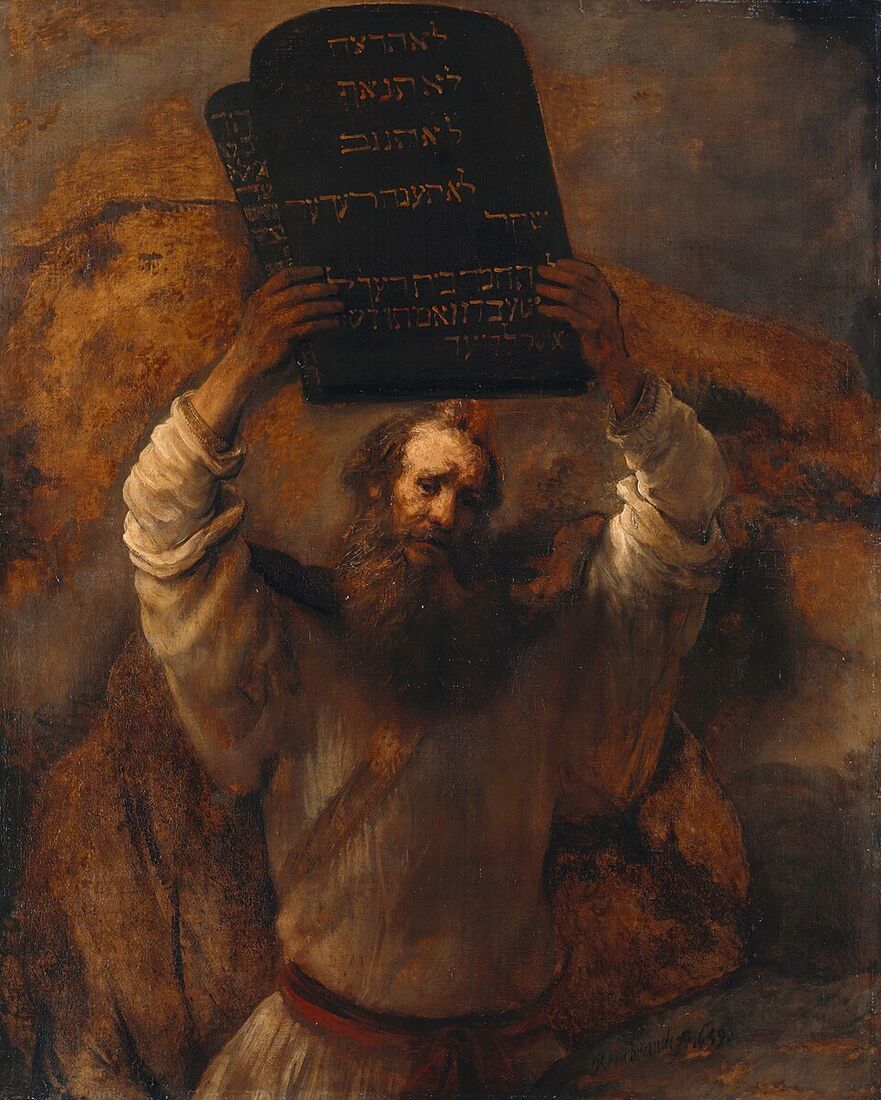
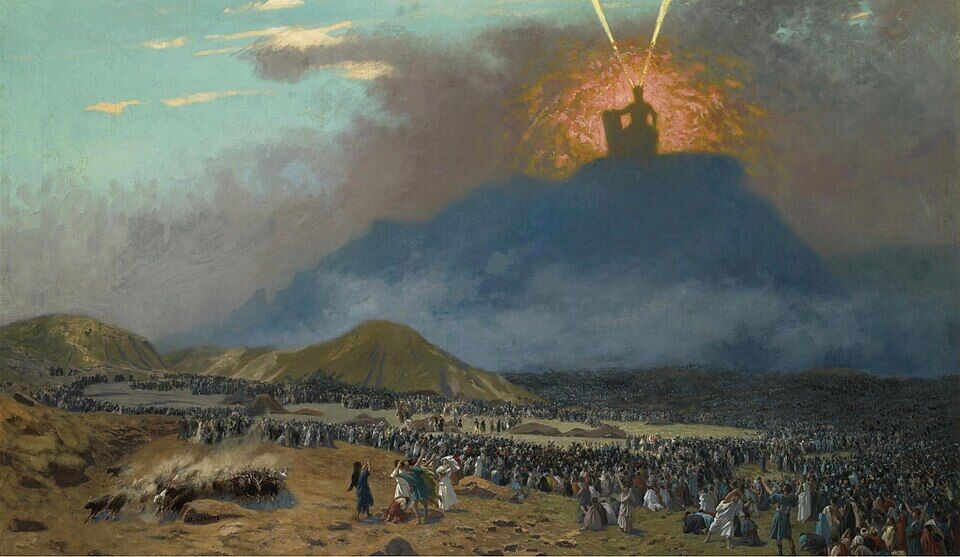
At the foot of Sinai — thunder, lightning, smoke: the mountain burns, and the people stand at a distance in terror. Here, in fire, the covenant is concluded, and the ten commandments are given. This is not a code of prohibitions, it is the spiritual core of the covenant, the conditions of life with God: after the first man preferred his own will to God's, the commandments restore the very possibility of following Him. They are arranged with an almost geometric clarity: four concerning man's relation to God, six concerning his relation to his fellow man. And these six are no riddle but simple, universally human things: do not lie, do not steal, do not kill, do not covet what is another's. For we ourselves do not wish to be lied to and stolen from — yet for some reason we demand this only for ourselves. The whole law folds into one: do not do to another what you do not wish for yourself. This is not a cage but a path back, out of an embittered world where each is for himself — to paradise. But here is what happens while Moses is on the mountain for forty days. The people are afraid before a God who cannot be seen, who speaks from the cloud — they need control, a god familiar and comprehensible, one that can be managed. And the whole people, in a common deed, takes off its gold and melts it — casts a golden calf, a bull such as was worshipped in Egypt. The sin is not in the metal, but in that the free, to whom God Himself spoke face to face, choose an idol they hold in their hands over the Living One, before Whom one must stand in trust. And yet the covenant is not annulled. God condescends: He gives a detailed Law, the Torah, spelled out to the smallest particular — not as an abolition of freedom, but as an instruction in holiness for spiritual infants, a barrier at the edge of the abyss. But even this is not kept under duress: for a long time Israel will have no king to compel it, for its King is God Himself, and the law is fulfilled freely — or not fulfilled at all. So on Sinai there arises for the first time the question that torments man always: whence does morality derive its authority, if there is no overseer above you — and why does the free man bind himself with a rule? Of this — the next station.
The Judges
collapse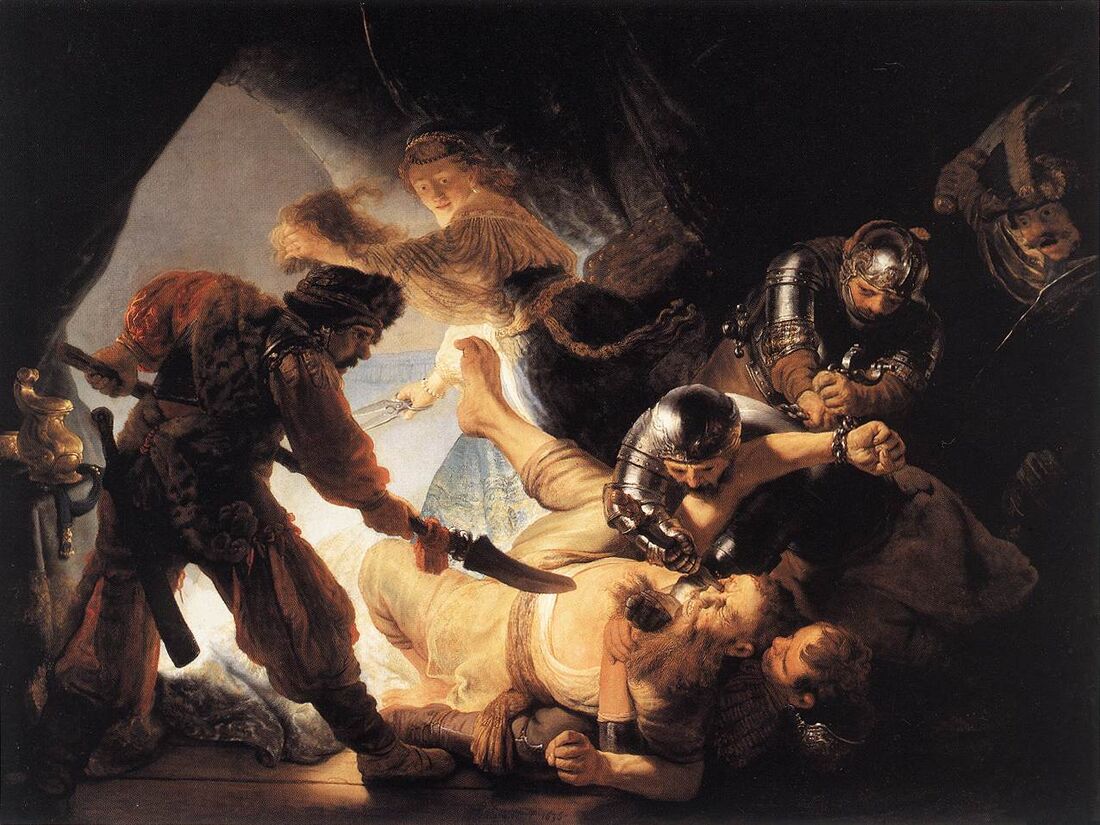
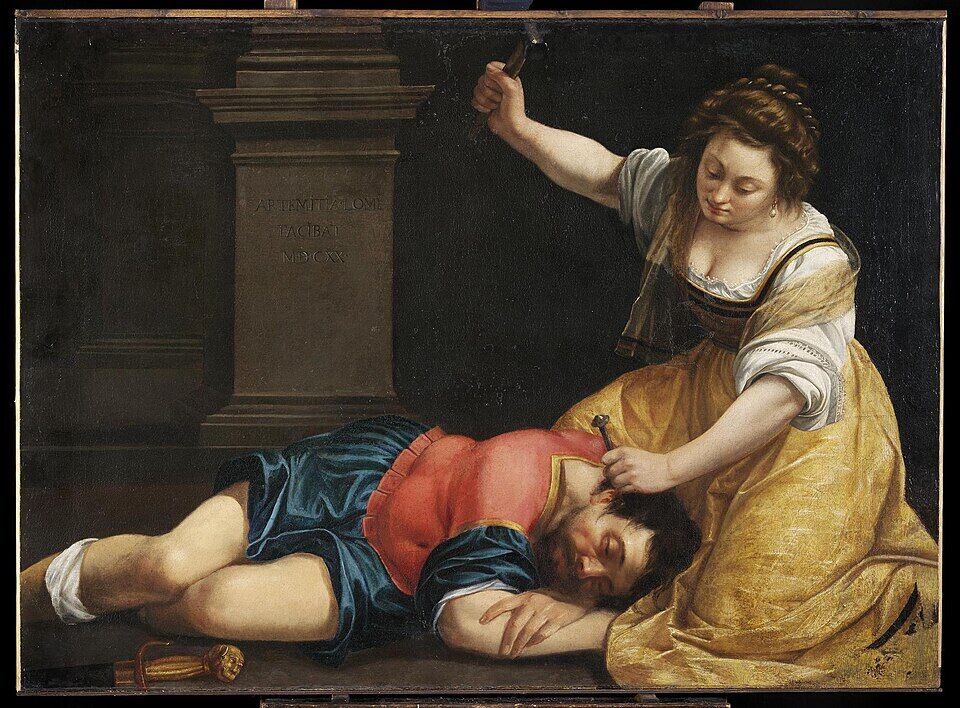
After Sinai, God attempts what no other people has had or ever will: to live with no power over themselves. For two hundred years Israel has no king, no army, no coercion — only judges, whom God raises up in the hour of need: ordinary people without a throne, whose only strength is what God gave them. But the cycle does not fall silent. The sons of the judges are wicked men, working iniquity at the very tabernacle; the people finally lose their way. The monstrous affair of the concubine at Gibeah takes place — she is dishonored and killed — civil war, anarchy. “In those days there was no king in Israel; every man did that which was right in his own eyes.” And this led not to freedom, but to bloody chaos. God’s direct rule through the judges showed this: even when God is near and manifestly at work, the free human heart forever turns aside to idols and to its own will. In despair the people come to the last judge, Samuel: “Make us a king to judge us like all the nations.” This is the culmination of apostasy: they refuse the calling to be a people whose King is God Himself; they want to shift the responsibility — to cast off the heaviest thing of all, freedom. Samuel’s heart is torn, but God says to him: “They have not rejected thee, but they have rejected Me.” And — here is all of God’s respect for man — He gives them a king, but at what cost: Samuel’s “constitution” is a list of the king’s rights — he will take your sons for the army, your daughters for servants, your fields and flocks, and you will be his slaves. But the people are unyielding: “Nay, but let there be a king over us.” So ends the only attempt in history at free rulerlessness — not because it is impossible, but because man could not bear it. Of this — the next station.
Kingship
collapse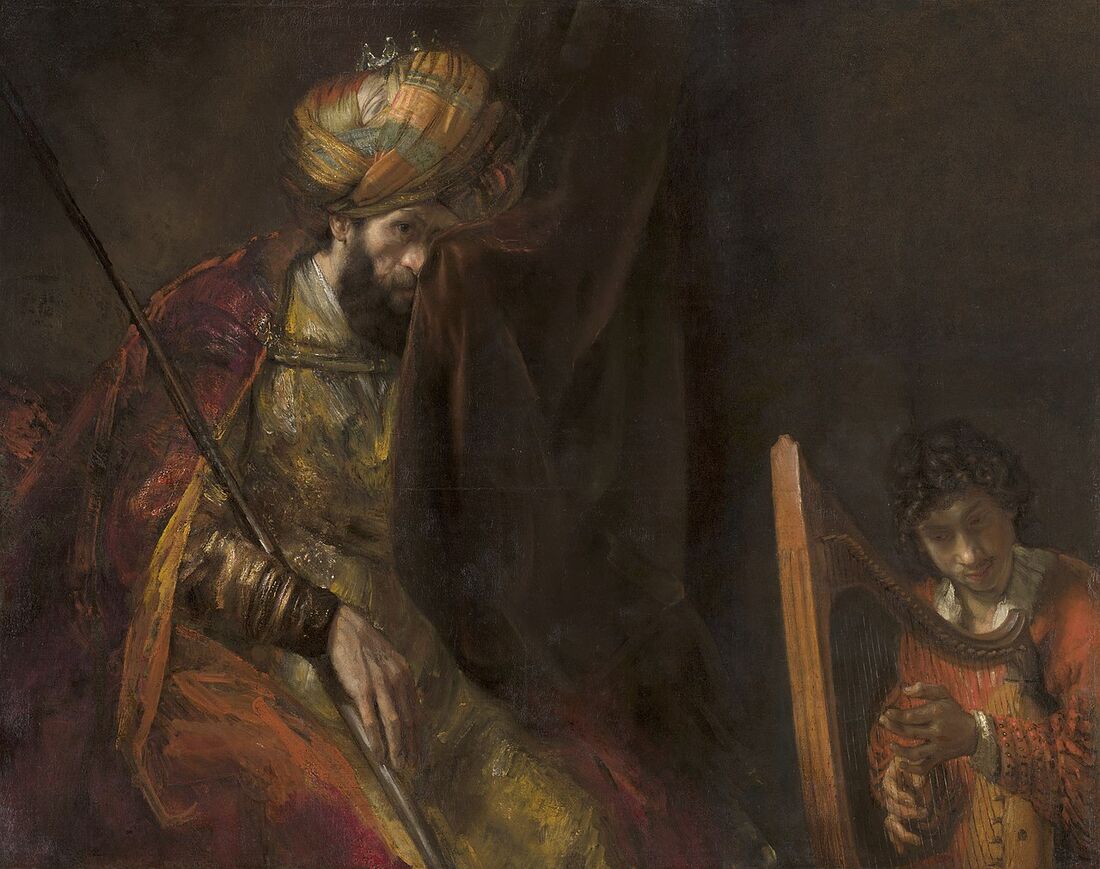
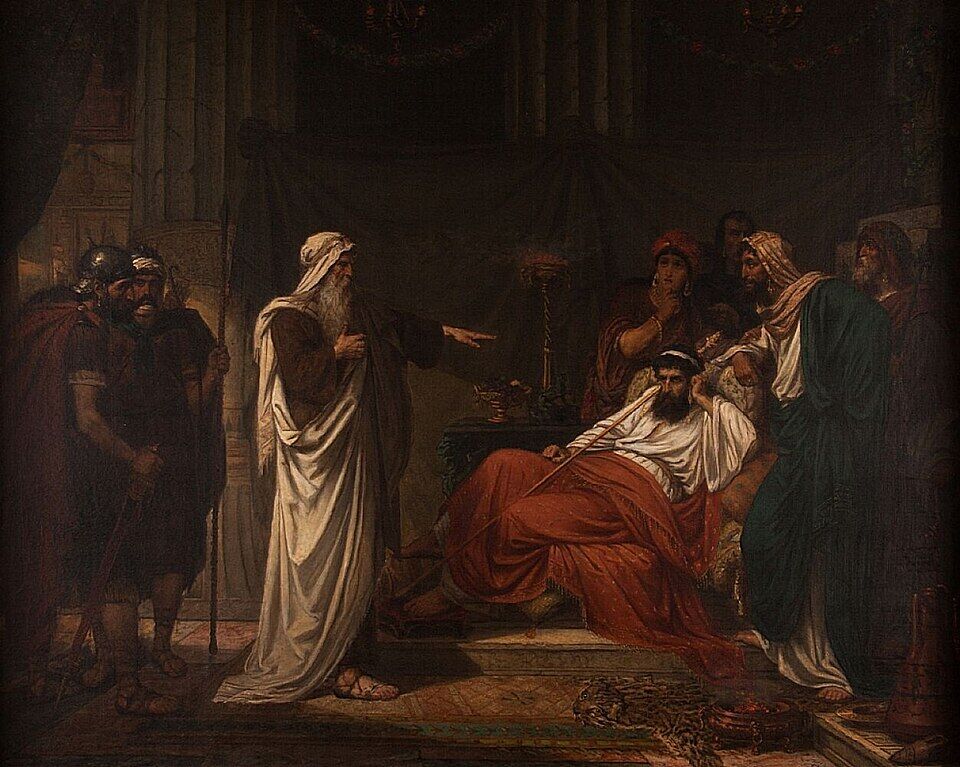
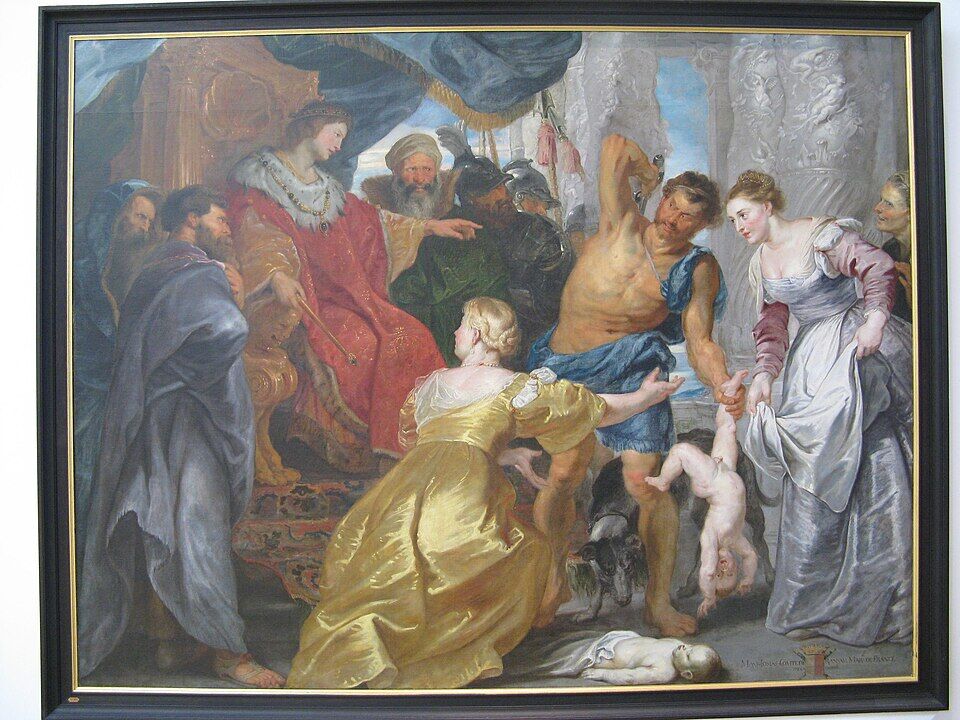
The people received what they asked for — a king “like the other nations.” But God sets a condition that no one around them has: this king will not be a priest. Among their neighbors the king is the chief sacred person, a living god; here he is only the ruler of the people’s flesh, while over the soul one God still reigns, and before Him each person remains free. Thus begins the tragedy of royal power. Saul is a king like those of all the nations: handsome, tall. But he does not know how to listen. At the decisive moment, not waiting for Samuel, he himself offers a sacrifice he had no right to offer — that is the work of a priest, not a king. Pride and distrust. And God withdraws from him. David is a man after God’s own heart, a poet, a warrior, a musician. But also an adulterer and a murderer: his affair with Bathsheba and Uriah is baseness, the blood of a faithful soldier sent to his death. And here, for the first time, a new force rises to its full height — the prophet: the unarmed Nathan enters the presence of the all-powerful king and, having told the parable of the poor man and his ewe lamb, points his finger at him: “you are the man.” But David’s repentance is a spiritual summit: in the fifty-first psalm, “you do not desire sacrifice… the sacrifice acceptable to God is a broken spirit; a broken and contrite heart, O God, you will not despise.” And God forgives him. Yet the consequences of the sin remain — the rebellion of his son Absalom; by Nathan’s word, the sword does not depart from the house of David, and blood pursues him to the end. Solomon is a sage whose wisdom drowned in compromises. He builds the Temple, but also erects shrines for his foreign wives. His heart, which had room for everything, in the end is shattered. The empire splits apart. The kings did not mend the situation — they only showed that the concentration of power in the hands of fallen man leads to a new form of tyranny and apostasy. And yet through this tragedy another note begins to sound: amid the venal kings the voice of the prophets grows ever louder, and through them — the promise of a strange King who will not use power at all: “a bruised reed he will not break, and a smoldering wick he will not quench,” he will not raise his voice in the streets, but will only judge in truth. Of this — the next station.
The Prophets
return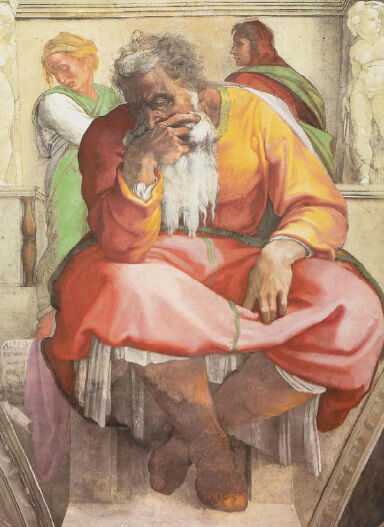
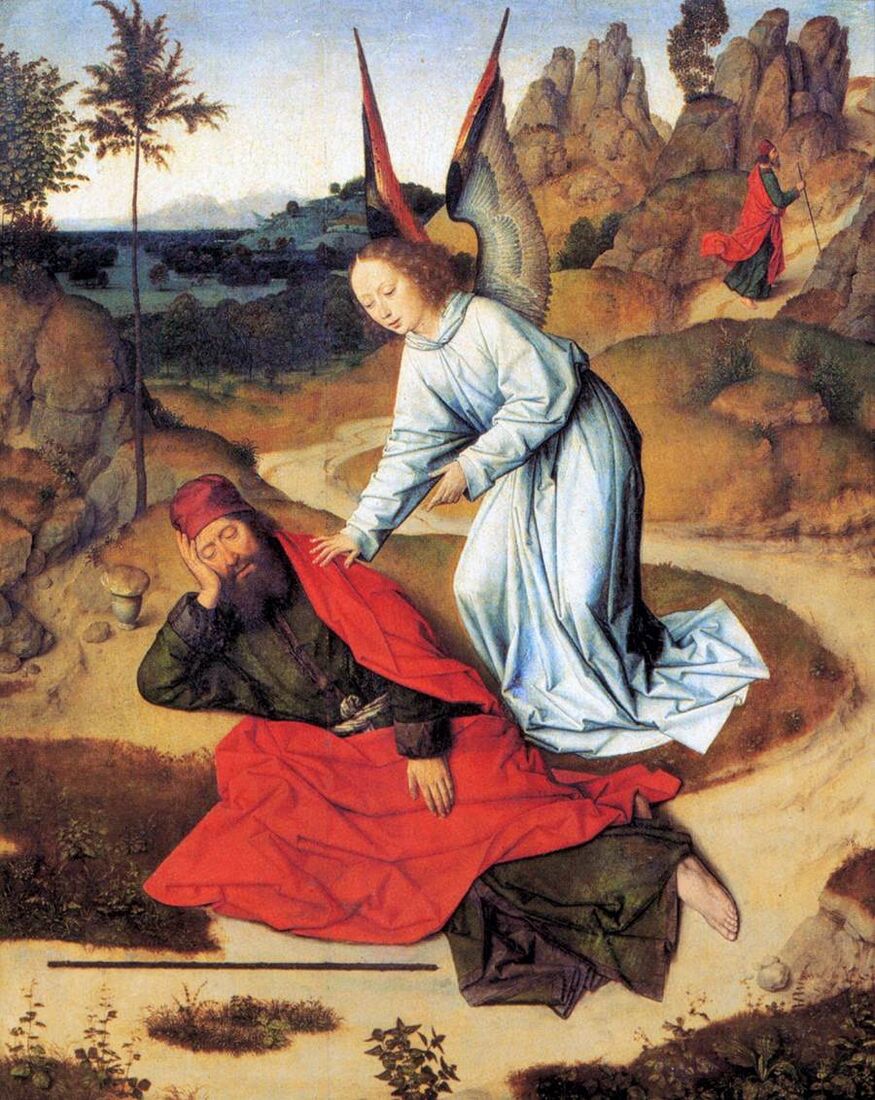
And then a voice rings out. The voice of the prophet. A prophet is not a foreteller: he is a man whose ear is tuned to the music of consequences, who sees how sin weaves the fabric of a coming catastrophe. With the division of the kingdom, a new and unheard-of power rises beside the king—the nabi, one who speaks not from himself but on behalf of God: the sole authority not subject to the throne. Only he could tell the king the truth to his face—and he paid for it as no one else did. Elijah stands alone against the four hundred and fifty prophets of Baal on Mount Carmel: "How long will you go limping on both knees? If the Lord is God, follow Him; but if Baal, then follow him." Fire comes down from heaven upon the sacrifice—seemingly a victory. But Queen Jezebel wants him dead, and the mighty prophet flees into the wilderness, sits down under a juniper bush, and asks to die: "It is enough now, O Lord; take my soul." And what of God? He is not in the storm, not in the earthquake, not in the fire—He is in the breath of a gentle wind, in a silent whisper. And to that same despairing prophet He reveals: you are not the only one left—I have preserved seven thousand who have not bowed the knee before Baal; and it is these unknown righteous ones who keep the land. Amos, a shepherd, delivers his rebuke at the very royal sanctuary: "I hate, I reject your feasts… but let judgment run down like water, and righteousness like a mighty stream"—and his words are a hammer that shatters ritual religion. And Hosea, whose harlot wife left him for others, lives out in his own life the very tragedy of God: his pain becomes a revelation that God is not a cold victor, but a suffering husband whose love has been betrayed. This is what the prophets are: the conscience of history. They stand as if struck down, reminding us that politics and culture are nothing without truth and mercy. And beside their loud voice, turned toward the nations, another is born, quiet, turned inward—and that one will ask not about the fate of kingdoms, but about the meaning of one innocent man's suffering. Of this, the next station.
Wisdom
collapse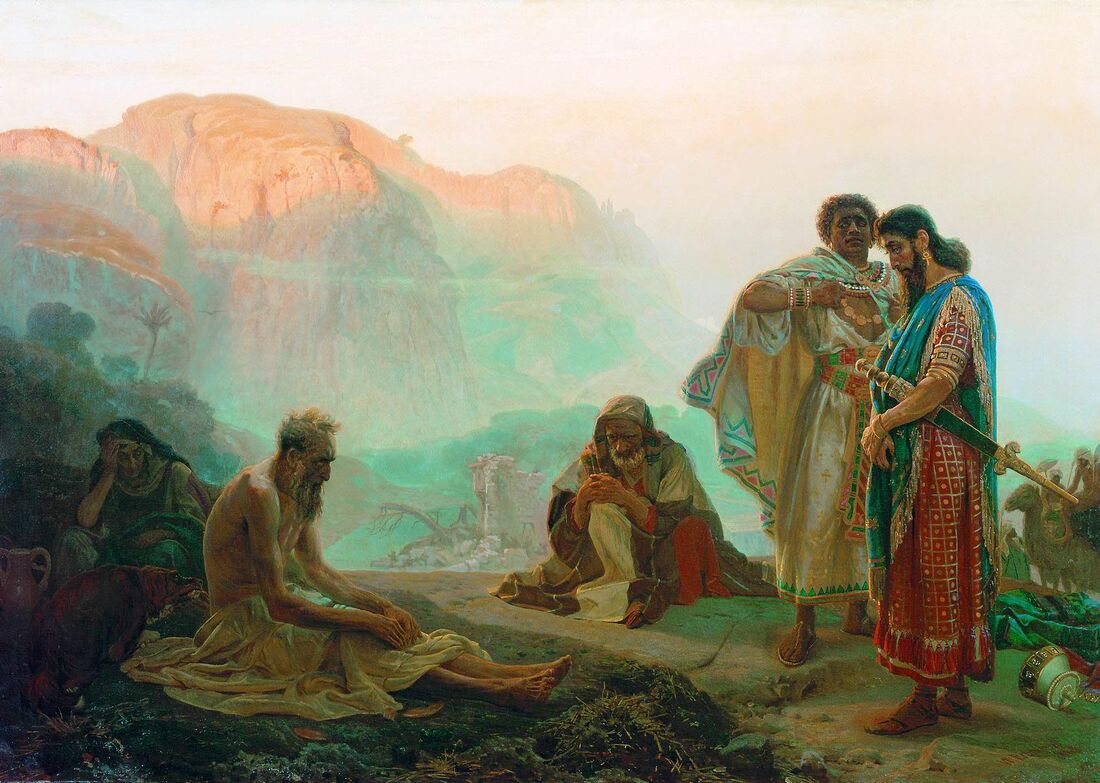
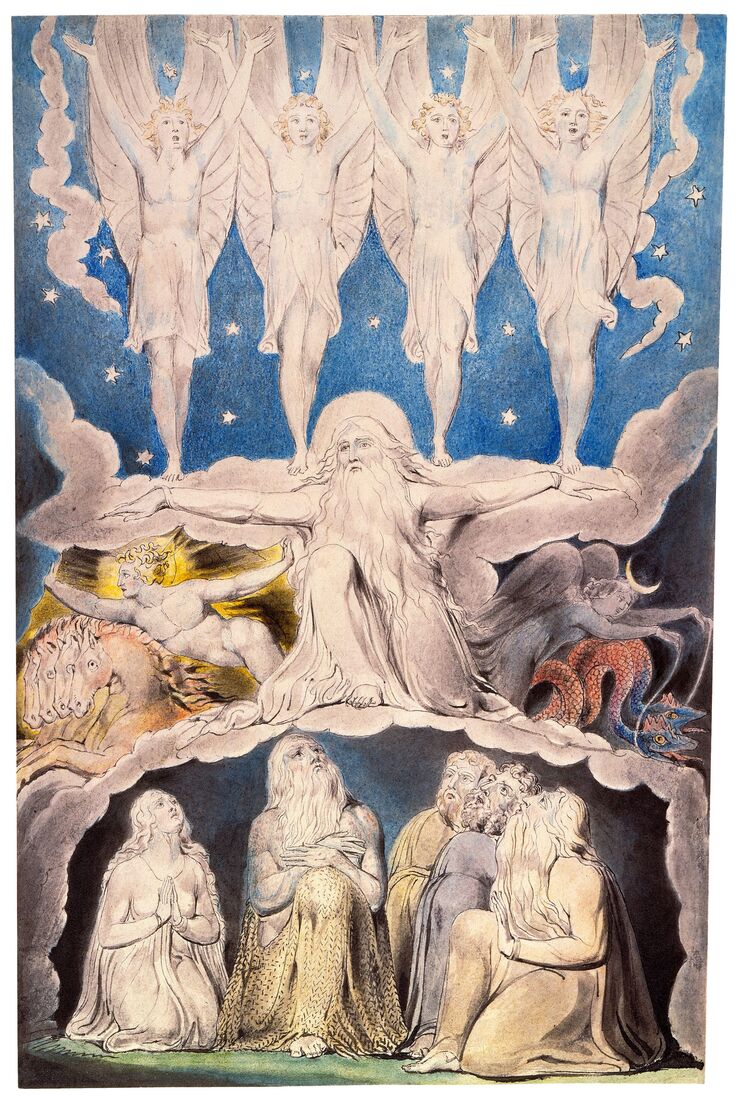
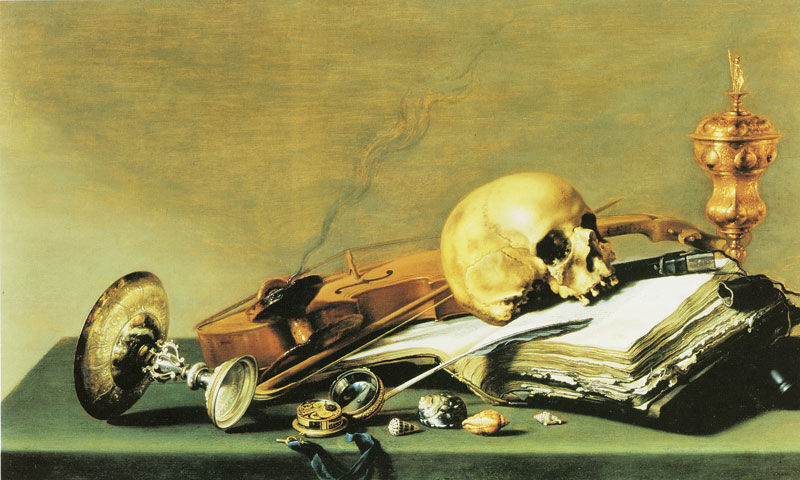
Together with the prophets is born a thought turned inward — the personal search for meaning. And its very first question is the most terrible. The Book of Job is a terrible story: a righteous man, who has in no way deserved calamity, in a single day loses his children, his wealth, his health. Friends who are theologians come to him and try to cram his suffering into the tidy scheme on which the whole former faith rested: "God is punishing you for your sins — repent, and He will restore you." But Job knows this is not so: he is pure — therefore the scheme lies. And here is what no one before him had done: he does not curse God, nor does he submit in silence — he demands a trial of God, cries out to His face, calls Him to a conversation. In this lies Job's holiness — he contends with God because he believes in Him in earnest; while his pious friends, defending the "correct" doctrine, in fact defend a scheme and not the living God. And God appears — but out of the storm, and gives no answer. He does not explain why; He Himself asks: "Where were you when I laid the foundations of the earth?" He appears not as a solution but as a mystery — and the meeting with Him itself becomes the answer that no explanation can replace. Job submits not before violence but before boundless majesty: "I had heard of You by the hearing of the ear; but now my eye sees You." The point is not why I suffer, but with whom I suffer. And alongside sounds another voice — Ecclesiastes, the bitter, seasoned sermon of one who has tasted everything: "Vanity of vanities, all is vanity." Wisdom, wealth, labor, pleasure — all passes, all is meaningless, if one looks "under the sun," out of earthly, temporal life alone. This is the cry of a soul that has tried everything and found no foothold in the world itself — and by that very fact a preparation for the revelation of eternity: if there is no meaning under the sun, then it is above it. These two books — tangles of doubt and torment — say what religion rarely admits: faith is not a calm certainty but often a struggle with God and with oneself. Of this — the next station.
The Captivity
captivity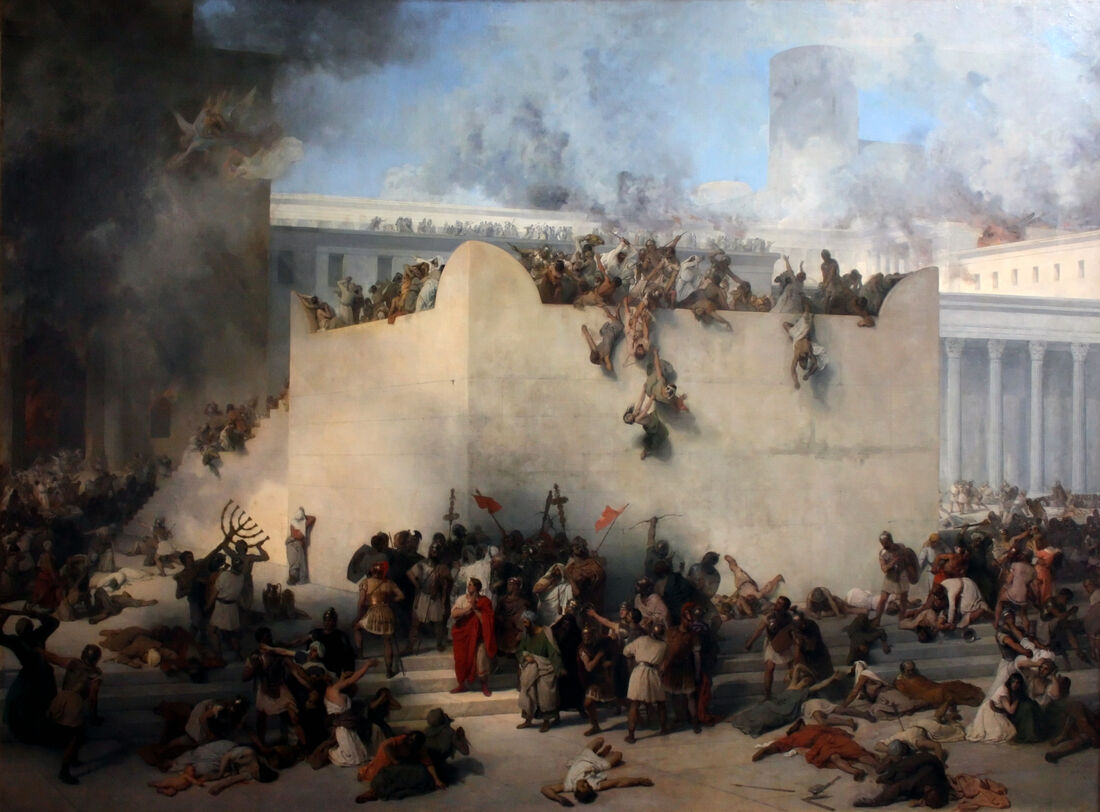
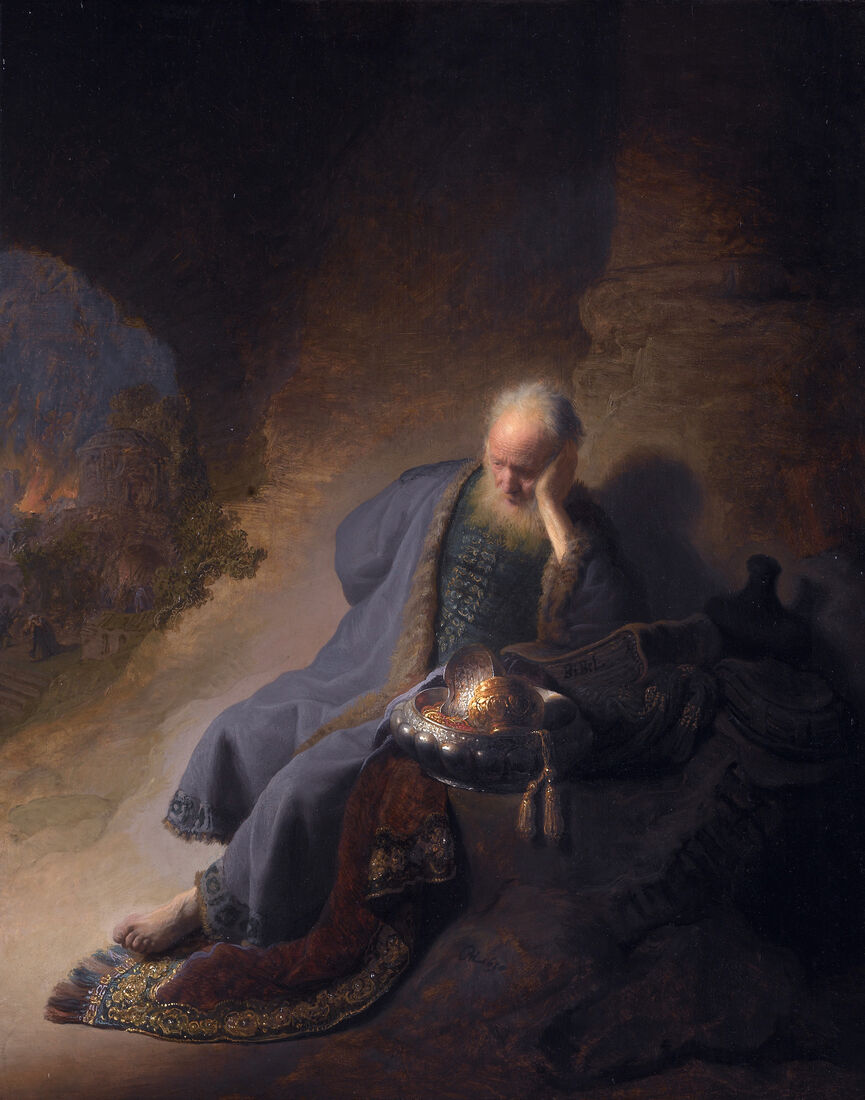
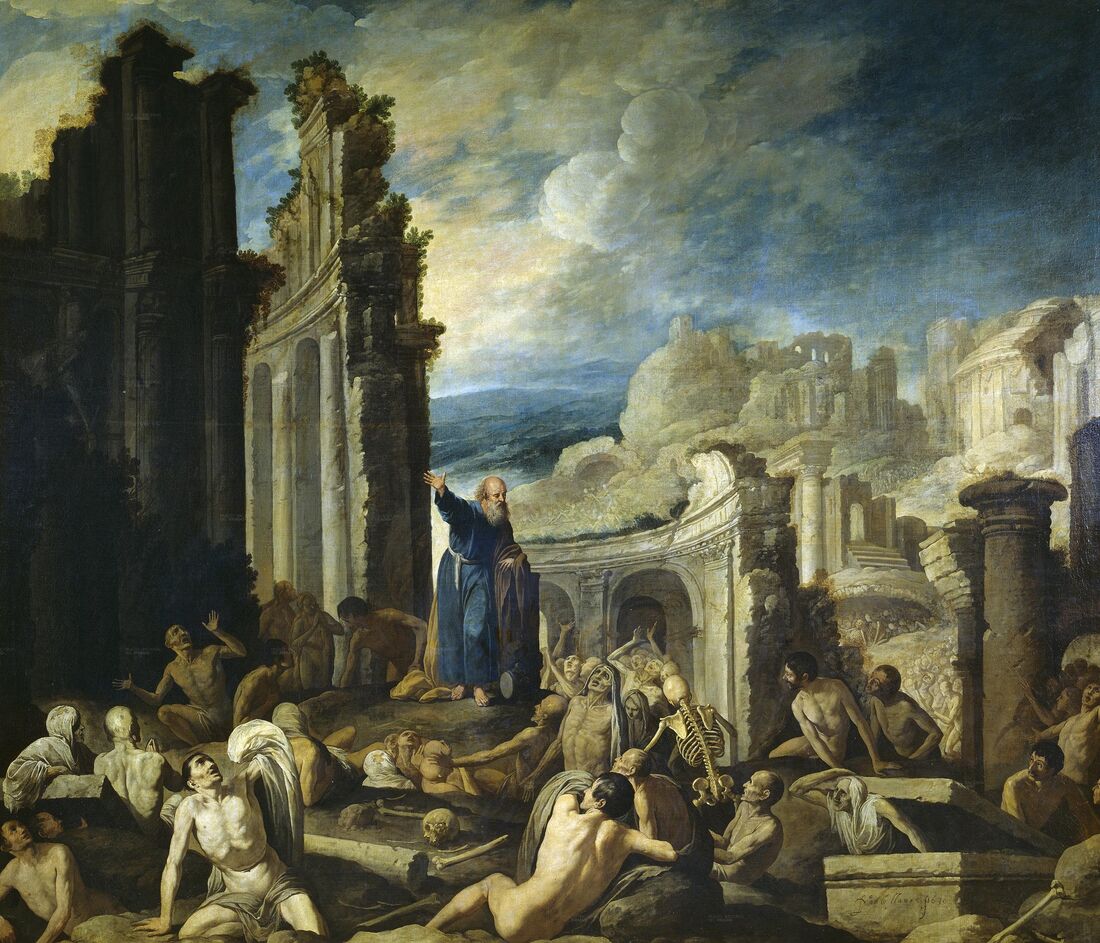
The collapse comes as it must — like a sentence long read out but never heard. First Assyria swallows the Northern Kingdom, then Babylon burns Jerusalem. The Temple of Solomon, the visible sign of the covenant, is turned to ash. It seems all is over, the design has failed: no king, no city, no Temple, no sacrifices — and so, by every former reckoning, no God, for in the ancient world a god dwelt in his temple and fell together with it. The descendants of those who came out of Ur of the Chaldees return in chains to the homeland of their forefathers. And here, in this hell of despair in a foreign land, there happens what no one expected. Stripped of temple, sacrifices, homeland — of everything on which faith rested — the captives discover a God who cannot be bound to walls: He did not burn with the Temple, He is here, in Babylon, with them. And if sacrifices cannot be offered, what remains is to listen and to remember. The synagogue is born — a house of assembly where no bullocks are slaughtered but the Word is read and studied; a personal rather than a ritual faith is born, one that needs no building and that no captivity can take away. The collapse that was meant to kill faith purified it. And in that same Babylonian furnace the prophets begin to speak no longer only of judgment, but of a mysterious way of salvation. Jeremiah writes astonishing words to the tormented captives: “seek the peace of the city whither I have caused you to be carried away, for in the peace thereof shall ye have peace” — God turns out to be not only the God of Israel, but the God of history, acting even through Babylon. And to Ezekiel is revealed a field strewn with dead bones: “son of man, can these bones live?” — “O Lord God, Thou knowest.” And the bones begin to come together, to take on flesh, the breath of life. This is a promise: God can raise up even a dead people — and so the last word belongs not to death. Of this — the next station.
The Waiting
captivity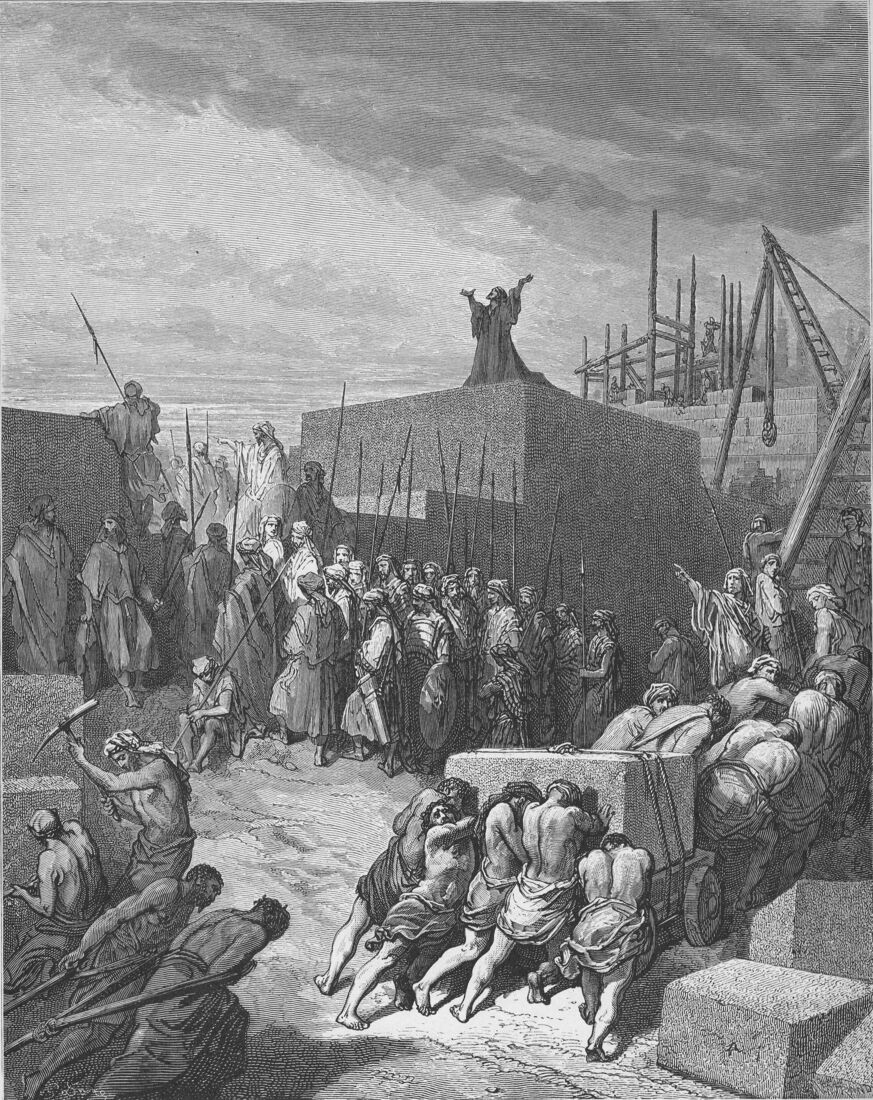
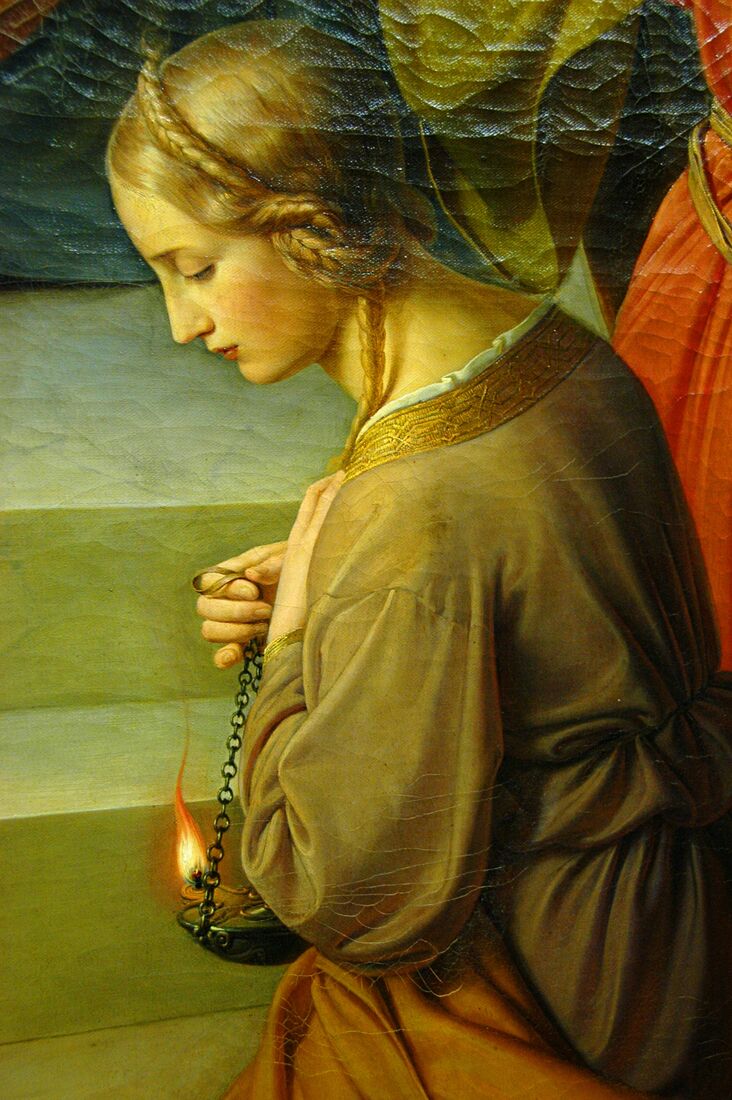
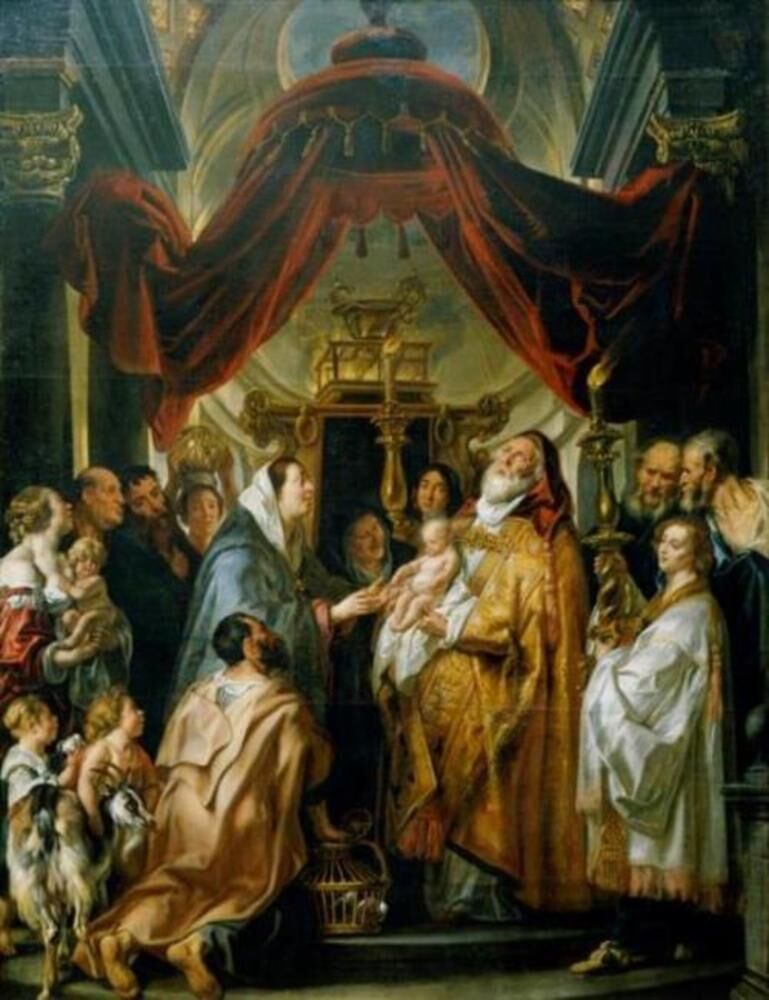
The Persians conquer Babylon and permit the Jews to return — but only a small part returns, a remnant, those for whom the faith of the fathers proved dearer than a settled life in a foreign land. They build the Second Temple, and at first a timid hope stirs among the people: the prophets Haggai and Zechariah inspire the building. But the temple, rebuilt anew, no longer shines with its former glory; the old men who had seen the first weep as they look upon it. Something essential had been lost. And then comes a trial that had not been known before — neither captivity nor conflagration, but silence. Malachi, the last prophet whose voice is entered into the canon, denounces no longer idolatry, but something perhaps more terrible — spiritual apathy, cynical formalism: “you say, ‘what a weariness it is to serve God’… you bring to the altar what is unclean, what is diseased. Can such things please the Lord?” And on this the voice falls silent. There come four hundred years of silence: God ceases to speak. This is the very heaviest of the questions of faith — not “why do You torment me?” but silence in reply; not catastrophe, but an emptiness in which it is so easy to decide that there is no longer anyone to listen. The people do not submit to Rome, they read the scriptures, they await the Messiah — but they picture Him to themselves as an obedient new David who will take up the sword and cast out the Romans; and so, when the meek sufferer promised by Isaiah comes, many simply fail to recognize Him. Religion freezes, splinters into parties — Pharisees, Sadducees, Essenes; the heart of the people, having passed through everything, is again covered with a crust. And yet in this silence there remain those who go on truly waiting: the old man Simeon and the prophetess Anna, who do not depart from the temple — those whose heart is ready to break but not ready to resign itself. The silence still endures. But it is precisely at its most muffled point, when almost no one is waiting any longer, that the first cry of an Infant will ring out. Of this — the next station.
The Incarnation
return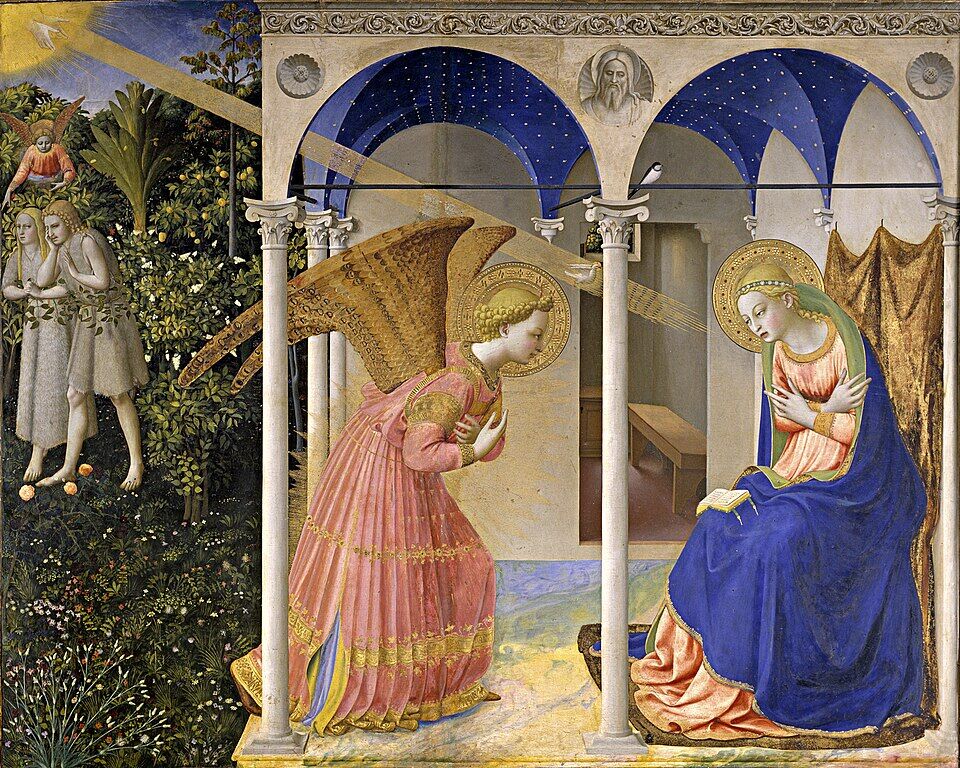
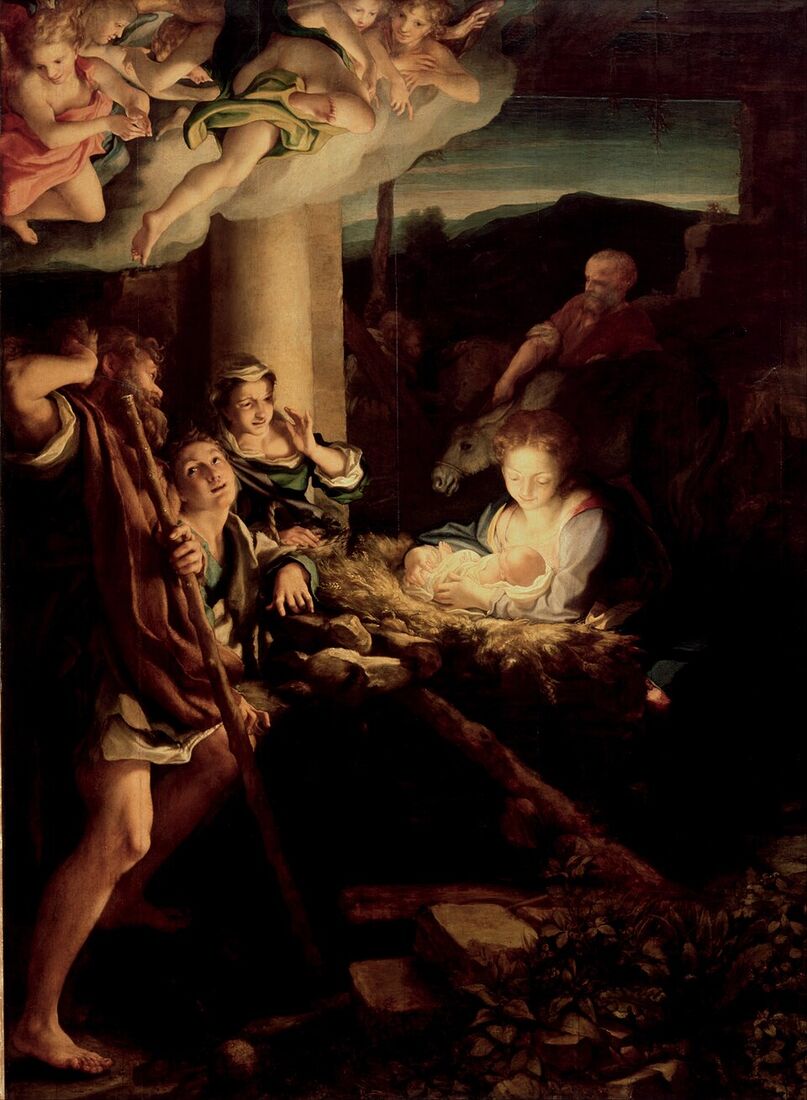
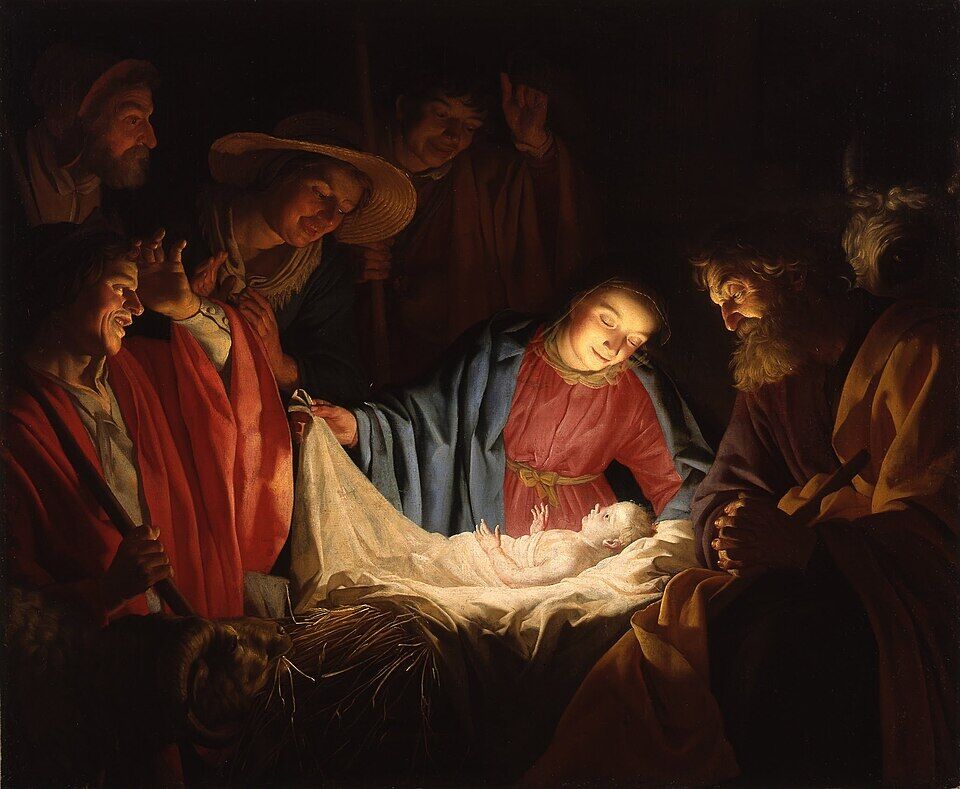
In Geertgen's dark night there is no moon, no torch, no angelic glow from above. The single source of light is the Child Himself. From Him, as He lies in the manger, a radiance streams forth, and in that radiance faces emerge: the bowed face of Mary, the muzzles of the ox and the ass, the coarse features of the shepherds, the wings of the angels. The light travels not from heaven to earth, but from the lowest point of the earth—from a feeding trough for cattle. This is the theology of the Incarnation, painted in pigment: God enters the world not as a force from above, but as a light from below, out of weakness.
The Apostle will call this by the word kenosis—self-emptying: "Who, being in the form of God… emptied Himself, taking the form of a servant, being made in the likeness of men." The eternal enters the temporal and consents to become finite. The boundless becomes an infant who can be swaddled. He who cannot be conceived becomes one who can be taken into the arms. God makes Himself vulnerable not as a stratagem and not as a means to future glory—vulnerability is itself the very manner of salvation.
And the first to come to the light are the shepherds. Here, for the first time, they are granted faces: the light streaming from the Child snatches them out of the darkness. Thus, from the very first scene, the theme of the whole drama is declared—the restoration of a face to those from whom it had been taken. The darkness of self-will, in which the old paradise slammed shut, is not dispelled by new thunder. Within it a light is born—defenseless, and for that very reason invincible.
The Ministry
return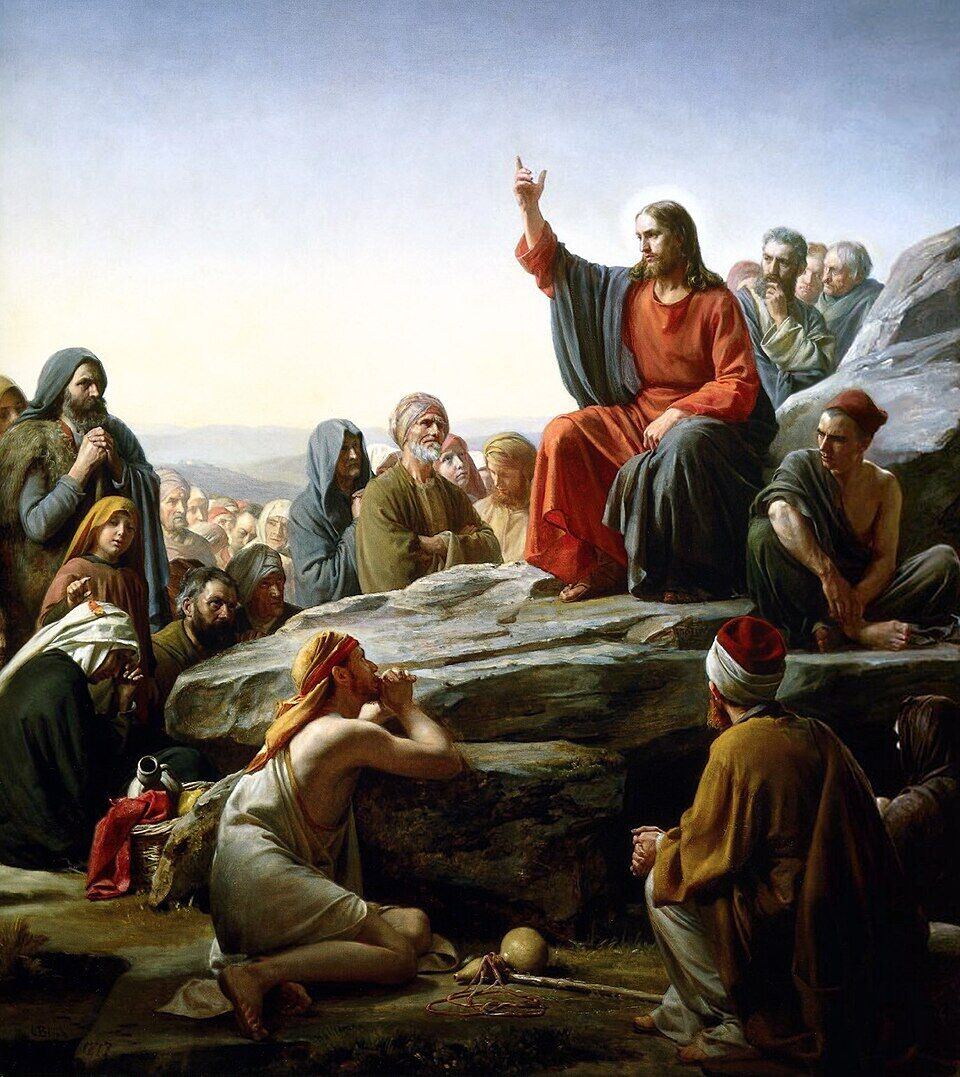
In Bloch's painting Christ sits not on a throne but on a hillside, and around Him is not a mass but a multitude of separate faces: an old man leaning forward; a woman with a child; a distrustful scribe; a boy peering up from below. The artist refused to paint a crowd — he painted faces, and each with its own story. This is the Kingship as Jesus brings it: not a new system, not a better law, not a more just empire, but an address to each Person individually.
The old drama had tried every system — the covenant, the Torah, the monarchy — and each proved to be only a barrier at the edge of the abyss. Jesus does not mend the system; He overturns the very scale of values. "Blessed are the poor in spirit… Blessed are those who mourn… Blessed are the meek, for they shall inherit the earth." The pyramid of the world is set on its head: at the bottom are the victors, at the top are the poor in spirit, those who mourn, the persecuted. This is not a morality for the weak, but a revelation of how reality is ordered when love, and not force, stands at its center.
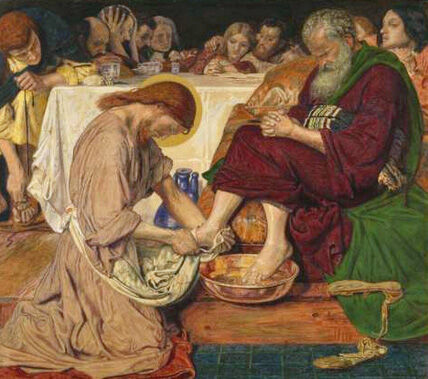
At the foundation of this overturning is service against domination, against objectification. The old king, in the word of Samuel, "will take your sons… and you shall be his slaves": power turns people into instruments. Jesus says the opposite: "whoever would be great among you must be your servant"; "the Son of Man came not to be served but to serve, and to give His life." He washes His disciples' feet. He has not even a place to lay His head. And His whole ministry is a succession of restorations of the face to the depersonalized: He touches the leper, who had been reduced to his disease; He speaks with the Samaritan woman, who had been reduced to her reputation; He calls Zacchaeus by name, who had been reduced to the trade of tax collector; He defends the woman reduced to her sin: "let him who is without sin among you be the first to throw a stone at her… neither do I condemn you." Each healing is an object become a Person once more.
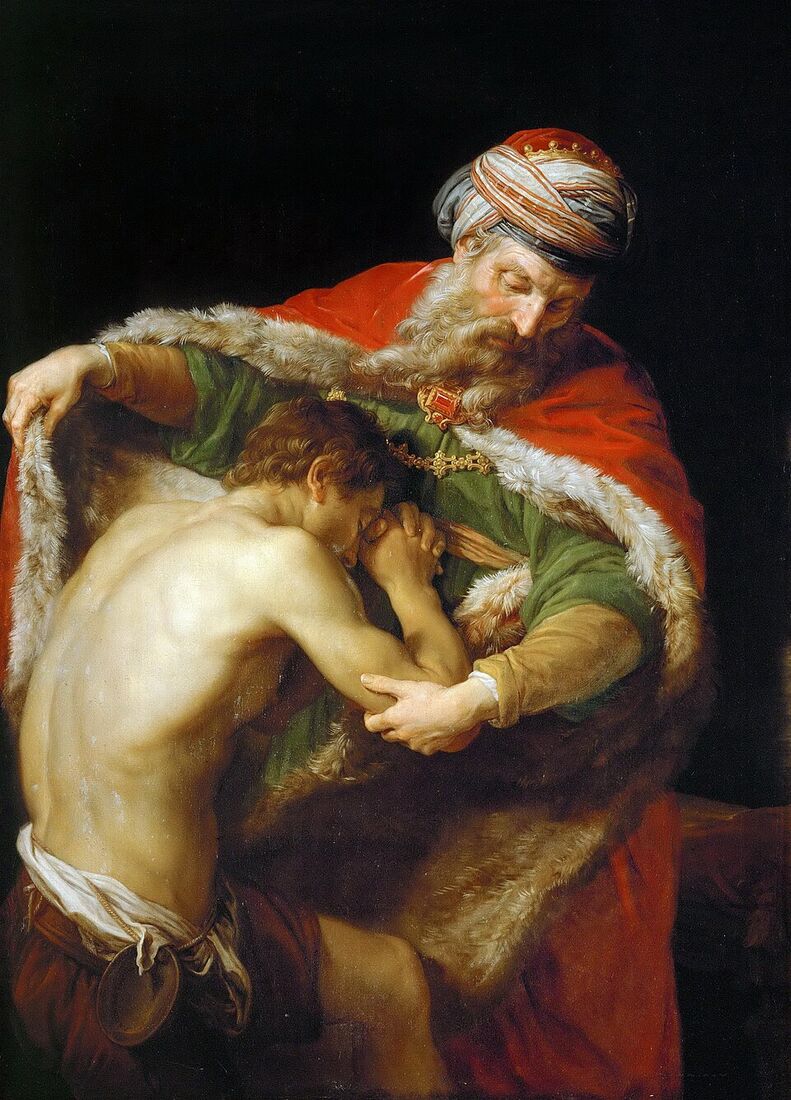
And in the parables sounds the chief news: God Himself has gone out to seek. The shepherd leaves the ninety-nine sheep and goes after the one that is lost. The woman turns the house upside down for one lost coin. And the father, seeing the prodigal son still far off, does not wait for his humble return — "he ran… and fell on his neck and kissed him." The One who in the old drama was sought in anguish now seeks of Himself — and runs to meet.
The Passion
return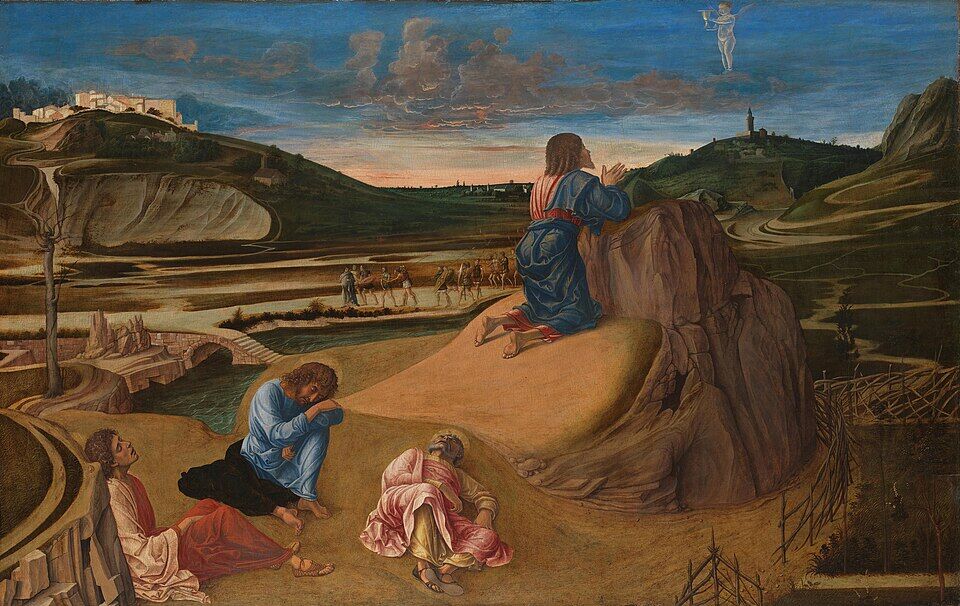
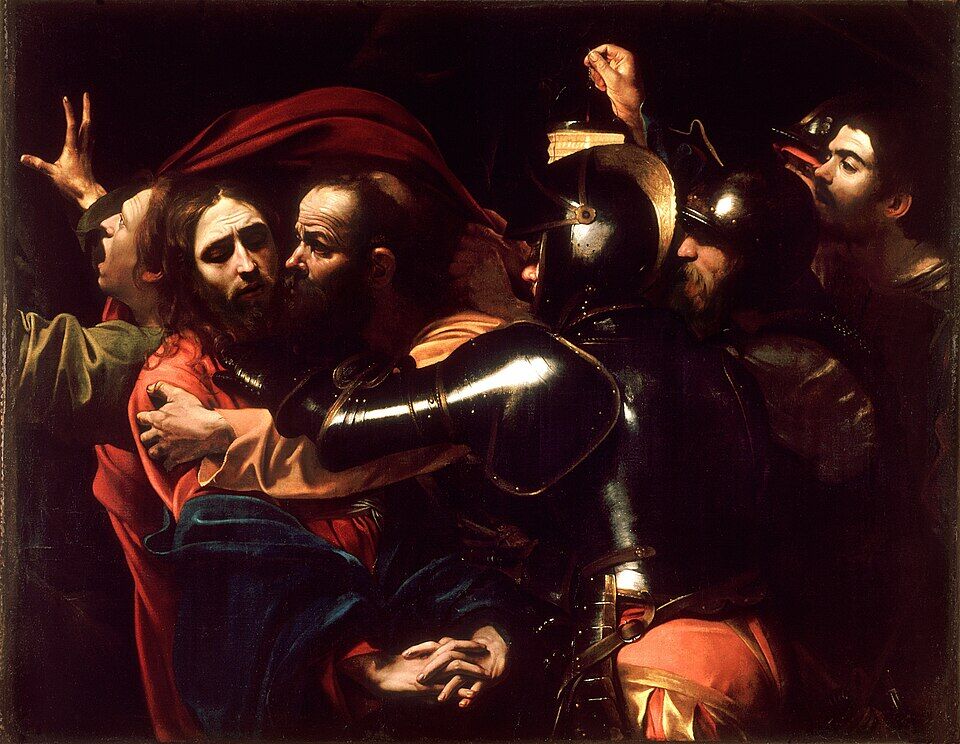
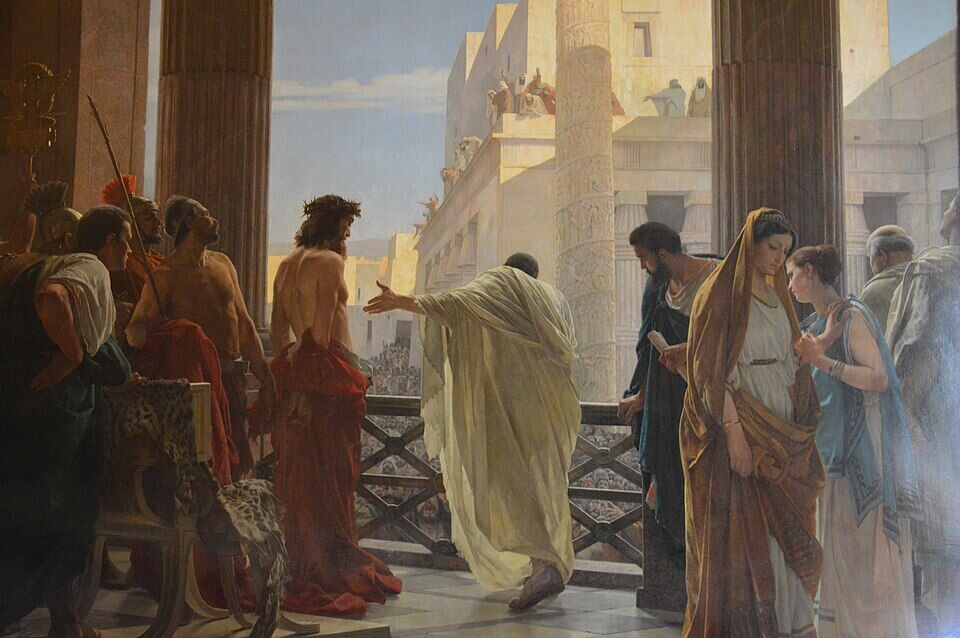
In El Greco, Gethsemane is painted as a vision, not a report. The figure of Christ, drawn out like a flame, in crimson and blue robes; an angel descending with the cup; the disciples asleep, curled within a fold of stone as though in a womb; and far off, in the cold light of torches, the crowd of Judas already drawing near. Past, present, and future are pressed together into a single stormy night. Everything is motionless — and everything trembles with the inner strain of choice.
Here everything is decided. “O My Father, if it be possible, let this cup pass from Me: nevertheless not as I will, but as Thou wilt.” This is the second great human “yes” — the echo of the Nazareth “be it unto me according to thy word,” with which the New history began. But now it is spoken not in glad tidings but in mortal anguish: “My soul is exceeding sorrowful, even unto death,” and “His sweat was as it were great drops of blood falling down to the ground.” No one drags Him. He Himself says that He could pray to the Father, and He would give Him “more than twelve legions of angels.” He is not a victim of circumstance. He chooses the cup.
And in this lies the heart of the whole theme. Objectification is when you are made a thing, a means, an instrument of another’s will. Its opposite is not power, but the gift of oneself. One compelled would be turned into an object; but Christ is not compelled — He gives Himself. Freedom is never so free as in this moment, when it freely binds itself with love. The disciples sleep; God begins to fall silent. Man is left alone with his choice — and chooses.
The Crucifixion
collapse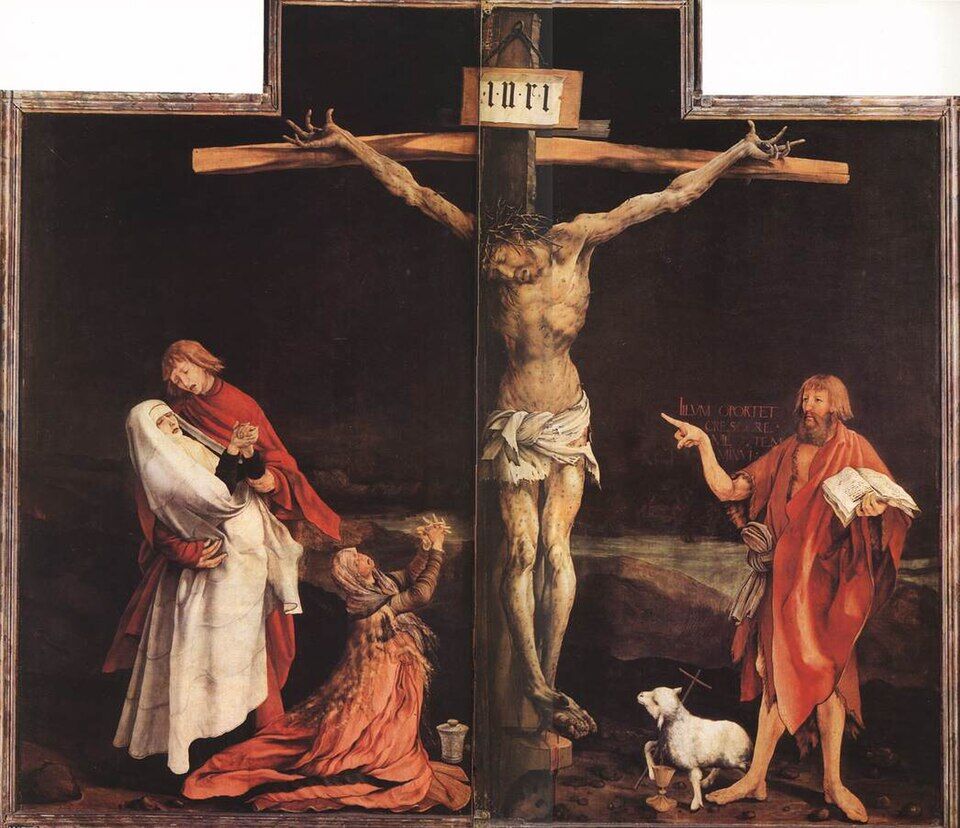
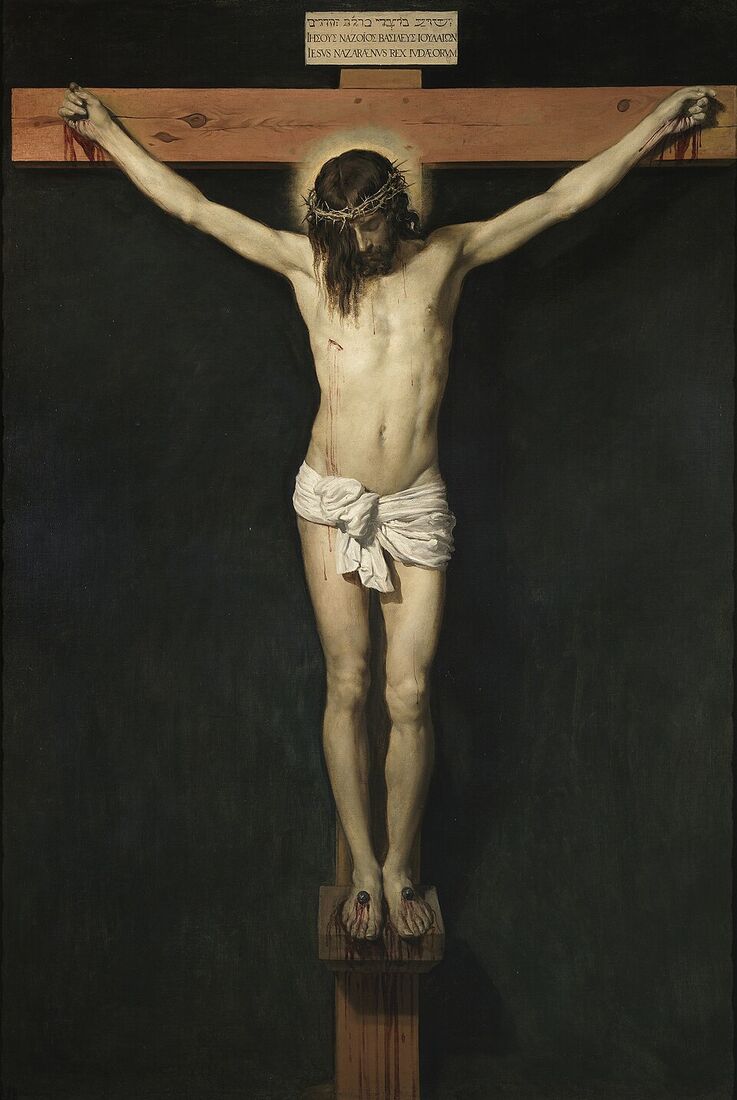

Grünewald painted the most terrifying Crucifixion in all of art. This is not the ideal body of a sufferer, but mutilated flesh: greenish-gray, torn by scourges, with fingers cramped in convulsion, covered with sores. The altarpiece was painted for the hospital of a monastery where patients were dying of “St. Anthony’s fire” — and the artist covered the body of Christ with the very same sores that were on the bodies of the dying, so that each of them might see a God who had taken upon Himself precisely his own disease. Nearby — Mary, sinking into the arms of John the Theologian, and the wrung hands of the Magdalene. And the huge finger of John the Baptist, pointing at the Crucified, with the words: “He must increase, but I must decrease.” At the feet — the Lamb, its blood flowing into a chalice.
From the cross there rings out what had not been heard in the whole of the ancient drama: “My God, My God, why have You forsaken Me?” The God who had spoken from the storm, from the burning bush, from the whisper of a gentle breeze, and who then fell silent for four hundred years — now falls silent even for the Son. And the Son enters into this silence, into God-forsakenness to the very bottom. This is the lowest point of the kenosis: God undergoes the absence of God. He who was boundless becomes the ultimate object — flesh that is seized, scourged, nailed, counted among robbers, a body that will be taken down from the tree.
And from the very bottom of objecthood, from the place where a human being has already been reduced to a thing, He refuses to reduce anyone whatsoever to a thing — even His executioners: “Father, forgive them, for they know not what they do.” Here is the limit of the theme: the one who was turned into a total object objectifies no one. He sees a face in the robber crucified beside Him: “today you will be with Me in paradise.” He sees a son in the beloved disciple and a mother in the woman standing at the cross: “behold, your son… behold, your mother.” The defeat of objecthood is accomplished not by fleeing from objecthood, but by descending into it to the very edge — and by a love that does not go out even there.
The Resurrection
return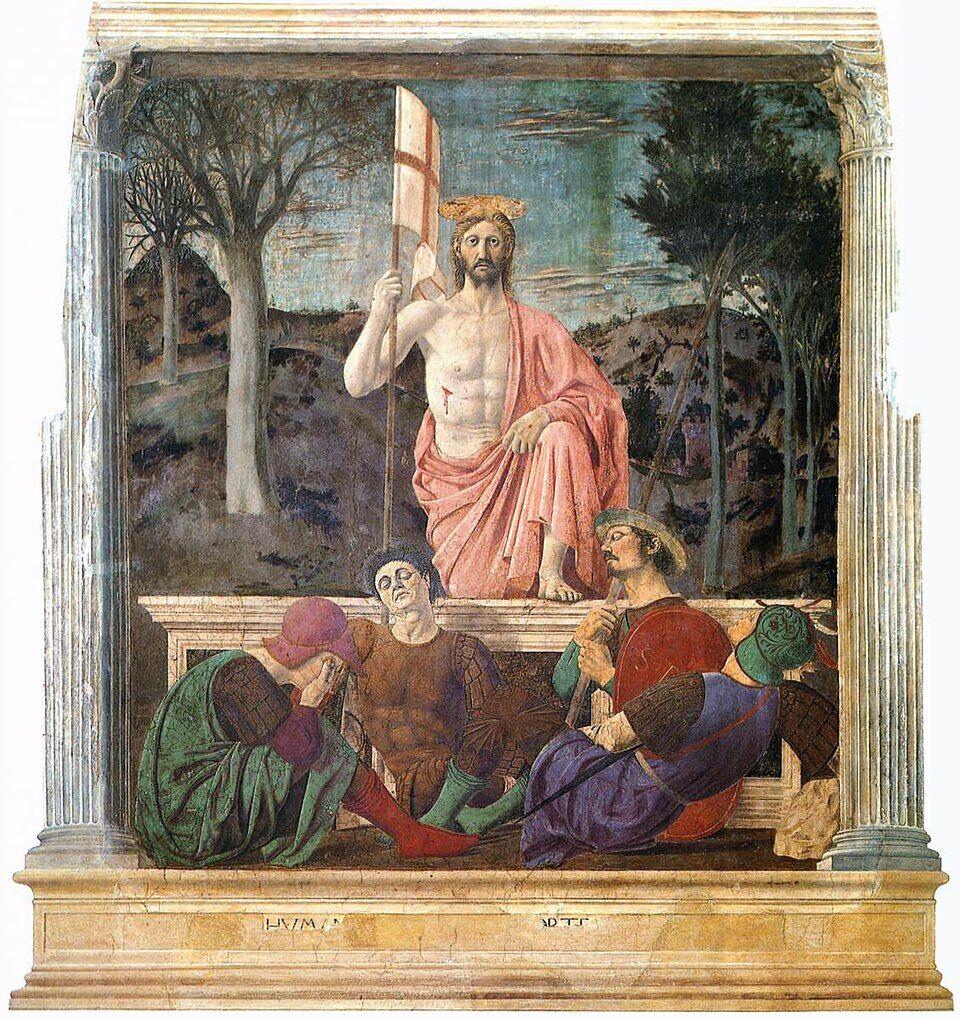
Piero painted the Risen One frontally, head-on. One foot is already lifted onto the edge of the sarcophagus, in His hand a banner with the cross, on His body the wound is visible, and His eyes—wide open, motionless, terrible—look straight at you and do not let you go. At its foot four soldiers sleep; in one of them tradition sees a self-portrait of Piero himself—a man who slept through the turning point of history. And the landscape is split in two: on the left, bare winter trees; on the right, green, living ones. Death and life are divided by the rising Body.
And here the voice changes. Until now the whole drama could be read as an archetype—and read honestly. An unbeliever, even an atheist, has the right to see in it the deepest myth of the human soul: you are the exiled Adam; you are the prodigal son trudging home; you are the one sleeping in Gethsemane; you are the one crucified by his own and forgiving them. Jung would say that the image of Christ is a constellation of the Self, and he would be right in his own way: "this is you yourself." Up to the tomb the drama is a mirror, and every soul recognizes itself in it.
But at the empty tomb the mirror cracks. The Resurrection cannot be tamed as an archetype without quietly emptying it out. It does not say: "you will feel renewal, as the trees turn green on the right." It says: He is risen—bodily, in history, as an event. This cannot be made a symbol of one's own psyche without changing the subject of the conversation. Here the archetype ends and confession begins. The voice changes from "this is you yourself" to "this is what I believe"—not "this is what you are," but "this is what I stake my life on."
And here, at the very wall, Camus stands beside us—and we honor him. In The Myth of Sisyphus he refuses the leap of faith, the "philosophical suicide," that is, the resolving of the absurd by leaping into consolation. He stands before the same blank wall—the silence of the universe, the thirst for meaning, a world that does not answer—and he refuses to lie, refuses to leap. His honest man is Sisyphus, consciously rolling his stone: "One must imagine Sisyphus happy." Camus does not cross the wall; he keeps faith with the absurd. The believer at the same wall crosses over—not by proof, for there is no proof here, but by confession: this is what I believe. Both stand at the same wall, both refuse the easy lie. One says the wall is final; the other, that one day at dawn a door opened in it, and a weeping woman mistook the Gardener for a corpse, and He turned out to be alive.
Honesty demands that one not pretend the wall is not there. The drama up to the wall belongs to everyone—it is a common human mirror. Beyond the wall it belongs to faith—or to its honest refusal. In this lies the whole boundary: "this is you yourself" is an archetype, true for each; "this is what I believe" is a confession that a particular tomb on a particular morning was found empty.
Let us gather the line. Berdyaev called the malady of history objectification—a deadening in which the person becomes an object, a means, a cog. The whole New Testament drama is its consistent defeat, played out in the body. In the Incarnation God becomes an object—a body, an infant—in order to ransom subjects from the fate of things. In the Ministry He restores faces to the depersonalized and refuses to lord it over anyone, washing feet. In Gethsemane He does not allow Himself to be turned into a victim of circumstance: the free man gives himself. On the Cross He descends to full objecthood—nailed, counted, taken down from the tree of flesh—and from there He objectifies no one, not even His executioners.
And in the Resurrection objecthood is defeated at its very root. For a corpse is the ultimate thing, the final triumph of the world of objects over the face; death is the place where objectification wins absolutely. And precisely there, where it wins absolutely, at the empty tomb it also loses absolutely: the ultimate object becomes a living Person, who looks at you head-on with the eyes of Piero's Risen One.
This victory can be read two ways, and the drama does not force the choice. As an archetype it is the eternal pattern of the Self's renewal, a mirror in which you recognize yourself: this is you yourself. As a confession it is the assertion that in a particular spring a particular tomb was found empty: this is what I believe. The drama brings you to this boundary and leaves you there—free. It does not push you past the wall. Berdyaev would say: the meaning of history is not within history, but at its edge, where eternity breaks through into time—and the focus of this breakthrough is the Person of one Man. History without Him is Camus's wall, honestly met, objectification without a cure. History with Him is the long defeat of objecthood, the slow return of the person.
The Old Testament was a map—a metaphysical map of humanity. The New is not a map, but a Person, who looks at you head-on and whose gaze does not let you go. And before this Person you stand as freely as Adam in the garden and as Mary in Nazareth—with that very premundane freedom to say "yes" or "no," with which it all began. The drama has led you to the wall and stepped back. Beyond that—it is you.
The Church
idol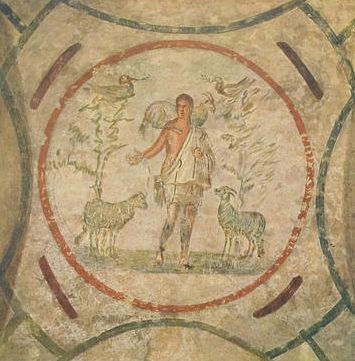
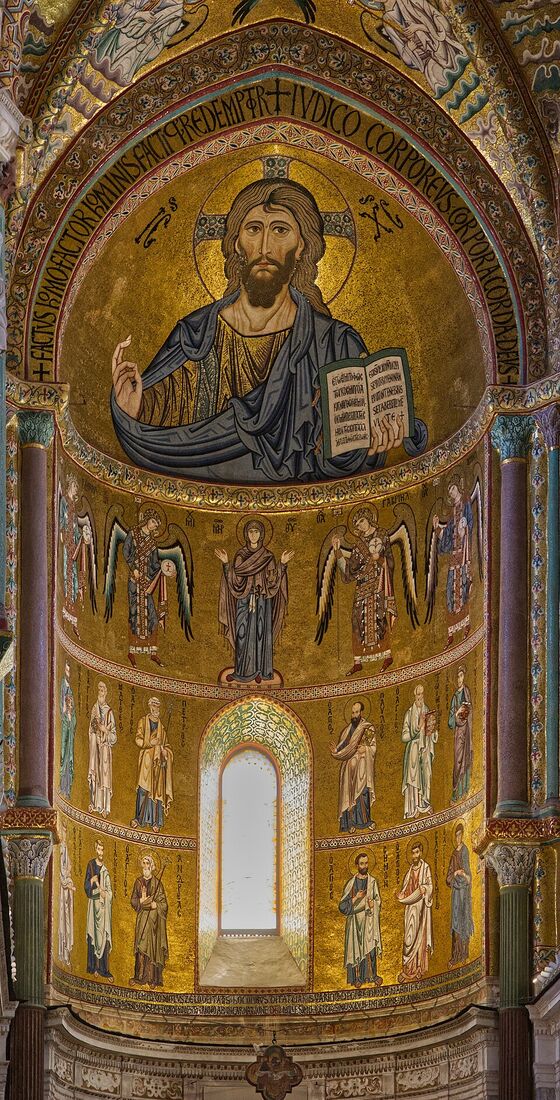
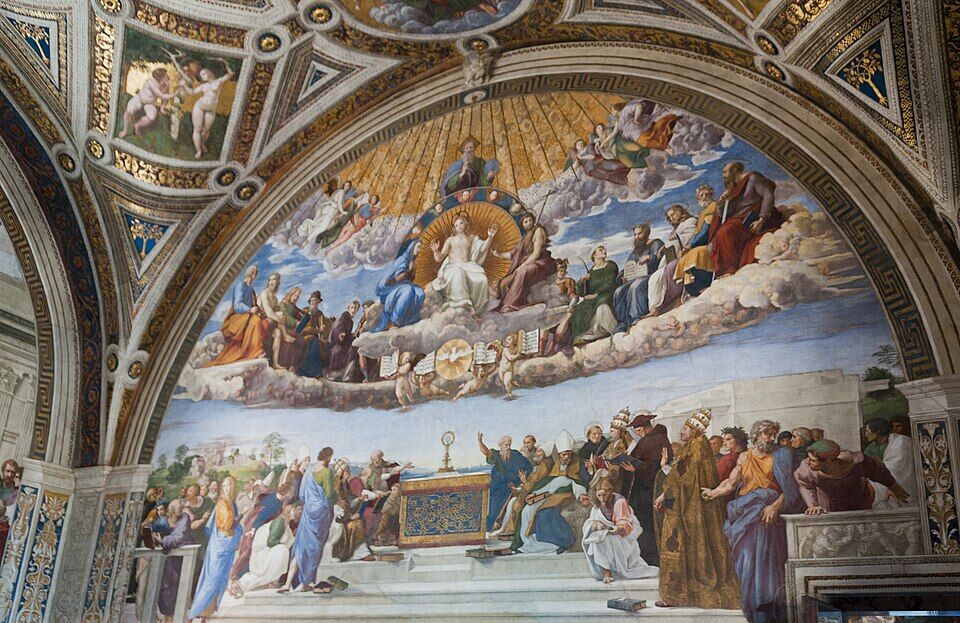
The earliest image of Christ is not the fearsome Pantocrator with a golden halo, but a young shepherd bearing a sheep upon his shoulders. He was painted on the ceilings of burial chambers, underground, the very posture borrowed from pagan bucolic. Here, in the catacombs, the Church is pure communion: no power, no property, no empire. Only the broken bread, the Name spoken in a whisper, and the dead, buried in hope. This is the direct continuation of the Ministry from the last drama: the restoration of the face to the depersonalized, the Kingship as a multitude of persons and not as a system.
Tertullian will write of these persecuted communities the phrase that will become their motto: "The blood of Christians is the seed." The more they are killed, the more of them there are. The Church of the catacombs has nothing but faithfulness — and precisely for this reason it cannot be objectified: there is nothing to confiscate, nothing to bribe, no apparatus to be seized. This is the Bride, not yet become a bureau.
Piero painted this night as a quiet miracle: the emperor sleeps in his tent, the guard has frozen still, and from above, within a circle of warm light, an angel descends with a cross. "By this, conquer." The most beautiful night in the history of the Church — and the most dangerous. Within one generation the persecuted becomes the privileged; the catacomb turns into a basilica; the Shepherd who bore the sheep ascends the imperial throne of the Almighty. The ideal becomes an institution, the institution becomes power.
Here is where the Berdyaevan line first cuts through in full force. The objectification of spirit is its fall into the world of objects, where living communion congeals into apparatus, into instrument, into a thing that can be owned and disposed of. And now it is no longer the individual man that is objectified, but the Church herself. The Cross — the sign of the defeat of power, the instrument on which every force died (of this was the whole last drama) — becomes a military standard, a sign of conquest. The symbol of the defeat of objecthood is conscripted into the service of domination.
Honesty requires that both hands be held here. Without the institution the memory would not have survived even a century: it was precisely the ecclesiastical order that preserved the Gospel, the canon, the sacraments, that carried the testimony through the darkness of the ages. Love had to take on a body in order to endure. But the body has its own weight: it constantly tends to confuse the Kingship with an empire, the Bride with a bureaucracy, the gift of the Spirit with an administrative resource. Berdyaev distinguished the Church as organism from the Church as organization, conciliarity from power: the first is life, the second a necessary and dangerous shell. The drama is that the shell forever tries to pass itself off as the content.
The Schism
collapse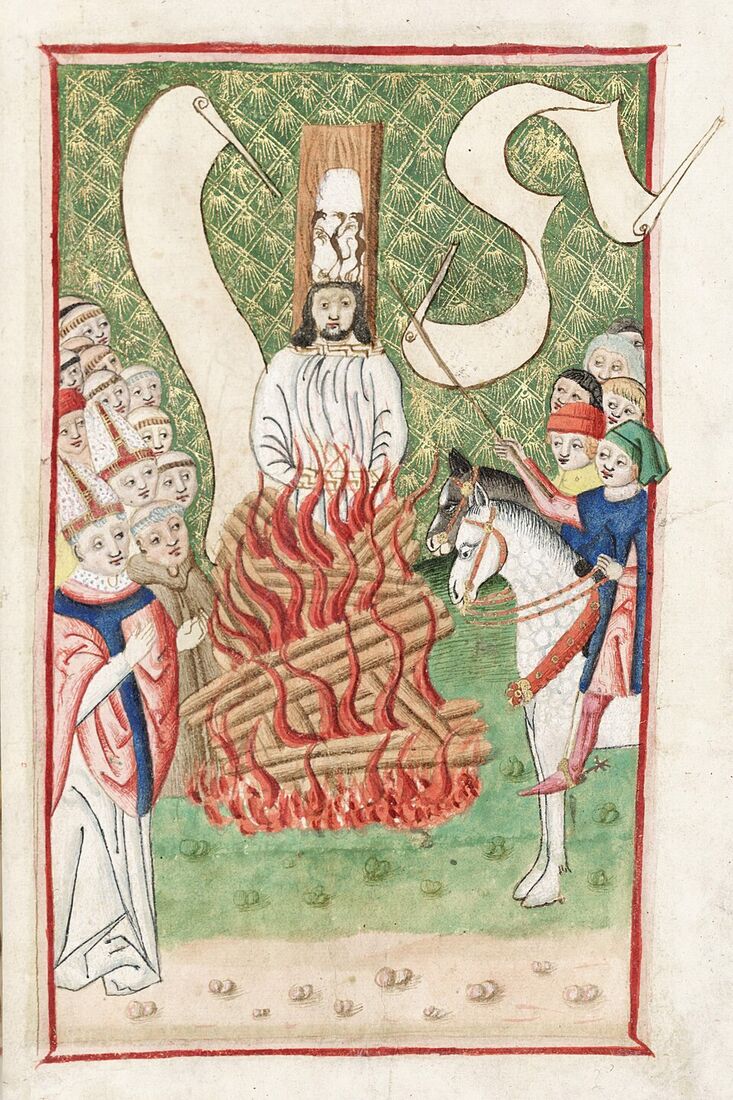
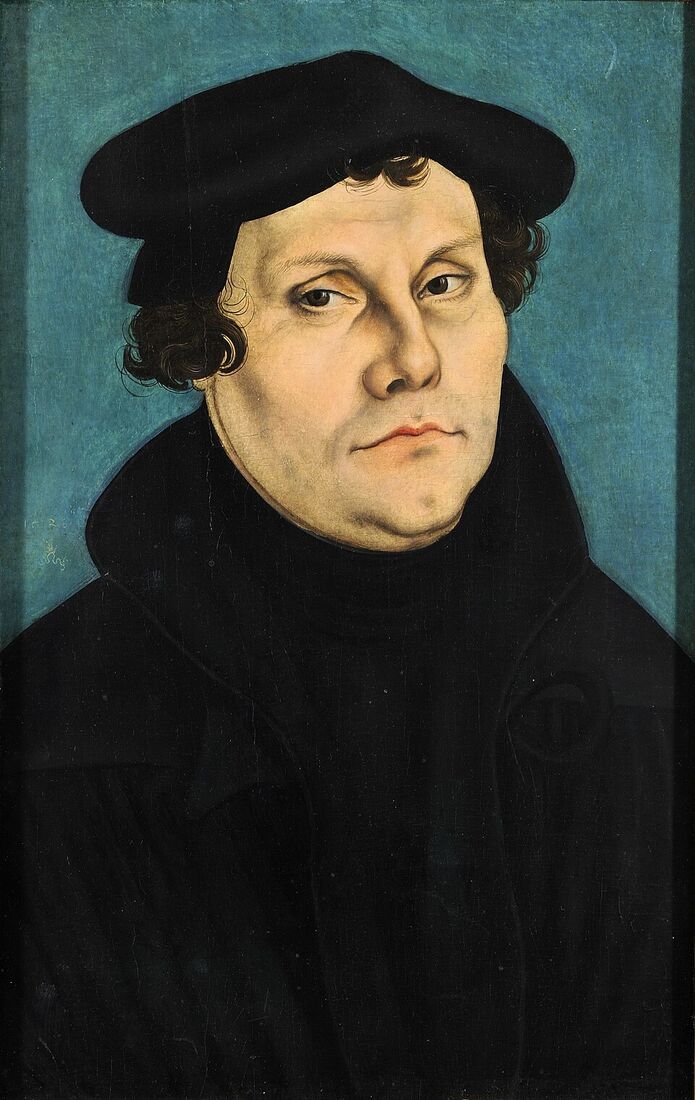
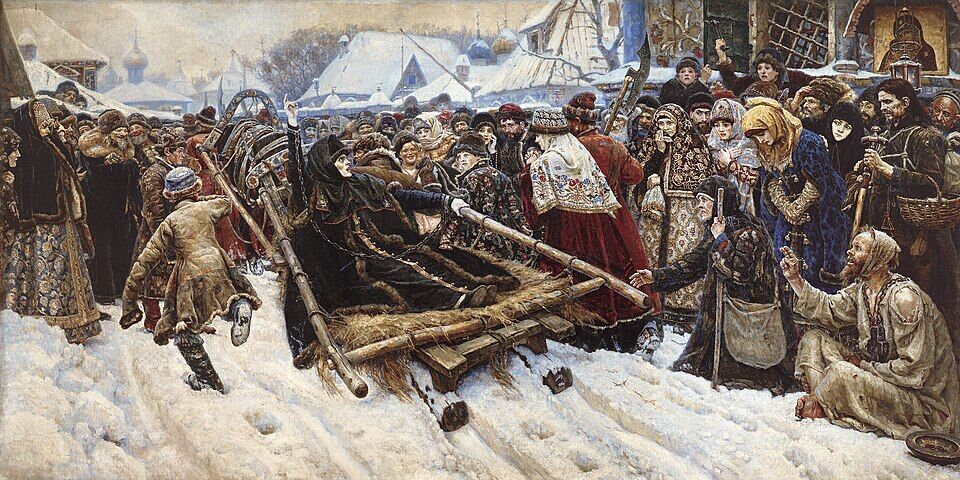
In Gethsemane, on the eve of His death, Christ prays not for victory but for unity: “that they all may be one; as Thou, Father, art in Me, and I in Thee, that they also may be one in Us.” And the deepest wound of the Church is not persecution from without, but division within: the rupture of East and West (1054), the Reformation, the Russian schism. Every schism is the prayer “that they all may be one” torn through living flesh.
Surikov painted not a doctrine but a face. Boyarynya Morozova is carried on a sledge through the Moscow snow; she throws up her hand with the two-fingered sign — the old sign of the cross — and the crowd answers with the whole spectrum of the human: some jeer, some weep, and a holy fool at the edge blesses her with those same two fingers. From the outside the dispute seems trivial: how many fingers to fold, how to write the Name (Isus or Iisus), which way to walk in procession. But beneath the dispute over form lies the question of whether truth can be established by the power of the state. The Church, having become a power, now turns that power against her own children in the name of unity. The apparatus, born to guard communion, begins to fracture it.
And here is the ultimate bitterness: both sides pray “that they all may be one” — and anathematize each other. Objectification has closed into a circle: each part, defending truth, turns the brother into an object — into a heretic, a schismatic, a subject to be corrected.
Berdyaev’s thread runs through this whole drama: the history of the Church is Spirit, which ceaselessly falls into objectification (institution, power, coercion) and ceaselessly breaks back out toward communion — through the saints, through monastic and spiritual revivals, through those who again and again descend into the catacomb. The institution is necessary, but it is not Life itself; Life is the communion of persons in the risen Christ, and it is always greater than its shell.
Here too runs the boundary between archetype and confession — this time a quiet one. As archetype, the drama of the Church is universal: every ideal becomes an institution, the institution a power; every revolution devours its children, every movement ossifies, charisma is routinized into bureaucracy. “There you all are” — this is the law of any human community, and read thus the Church is only one more instance of the eternal plot about a flame locked in an institution. But behind this lies the confession: that this Body, in spite of Constantine, in spite of schisms, in spite of the blood it has itself shed, is not merely a sociological institution but the presence, enduring through time, of a risen Person; that “the gates of hell shall not prevail against it” — not because the institution is pure, but because the One who lives within it is alive. The archetype says: a flame in an institution. The confession says: the Body of the living Christ. The boundary lies between “the Church is a beautiful and tragic human thing” and “the Church is the risen Christ, stretched out through time.”
As for us — we stand at this quiet wall as free as we stood at the loud one. And the one thing the drama counsels us to carry with us is the memory of the catacomb. When the institution again becomes a power, the remedy is always the same: the Good Shepherd, love without power. The Church is at her healthiest when she remembers that she began underground — with no power at all, with one broken loaf of bread and a Name spoken in a whisper.
Secularization
captivity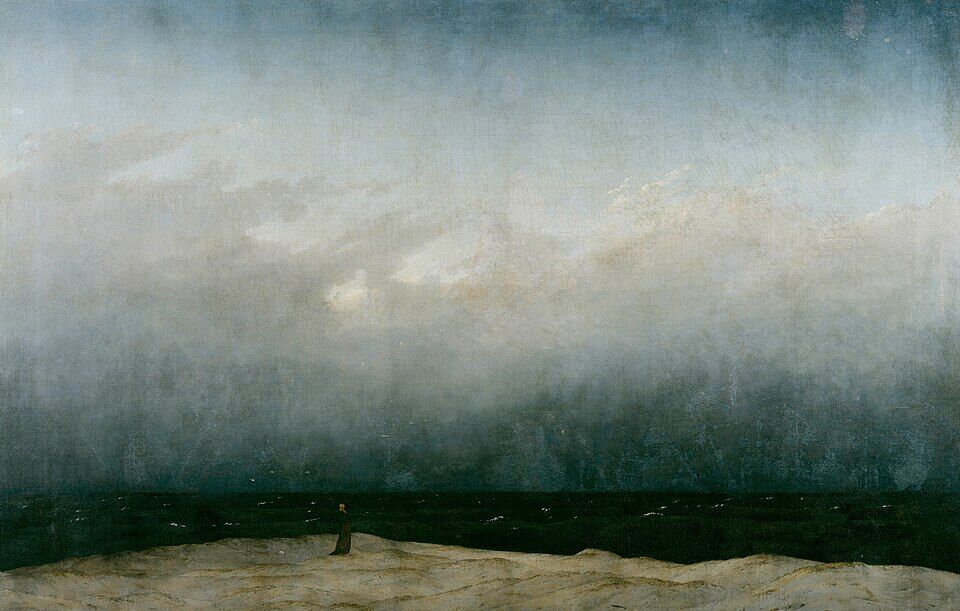
Friedrich painted the most radical reduction in all of Romanticism: an almost empty canvas — a boundless sky, a dark strip of sea — and on the narrow rim of the shore a tiny monk. No ship, no anchor, no second figure. This is precisely the condition of modern man: faith stripped of all its supports, standing alone before the silence. That same wall before which, in the previous drama, Camus stood. And before this wall four voices arise, which must not be turned into straw men — they must be heard in their full strength.
Feuerbach. Theology is anthropology. God is a projection of the human essence: our reason, our will, our love, alienated into the heavens and returning to us as something foreign and higher. “The consciousness of God is the self-consciousness of man.” His truth: we do indeed project; an enormous part of what is called “God” is a self-portrait of humanity, and to worship it is idolatry.
Marx. Religion is “the opium of the people,” but one must read the whole thought: it is the sigh of the oppressed creature, the heart of a heartless world, a consolation that makes the unbearable bearable — and thereby postpones its overthrow. His truth: religion has indeed been put to use to sanctify oppression, to command the poor to endure and to wait for a reward in heaven. A real wound has been named.
Nietzsche (§125, “The Madman”). In broad daylight a man with a lantern runs out into the marketplace and cries: “God is dead… and we have killed him.” He does not triumph — he is in horror: who gave us the sponge to wipe away the whole horizon? are we not falling through an infinite nothing? Nietzsche saw more clearly than the complacent believers the abyss that opens when the foundation departs — and he refused the cheap substitutes (a god hidden away in “progress,” “science,” “morality”). The God who died for him is the moral God of resentment, the otherworldly God who devalues life here below. Perhaps such a God ought indeed to have died.
Freud. Religion as illusion — not necessarily an error, but a wish-fulfillment: a cosmic projection of the father, a longing for protection, a collective neurosis. His truth: faith does indeed sometimes become an infantile consolation, a refusal to grow up, a heavenly Father who guarantees that we are not alone.
Now let us look closely at their quarry. In each case it is the God-object that is killed: God-as-projection (Feuerbach), God as social opium (Marx), God as guarantor of morality and prop of the horizon (Nietzsche), God as cosmic Father-protector (Freud). This is the God of objectification: a God conscripted as a guarantee, a consolation, a means of control, a heavenly overseer.
And the whole earlier map has already shown that such a God ought to die. The Old Testament drama is a God refusing to be a tribal god of war. The New Testament drama is a God refusing power and dying in God-forsakenness. The drama of the Church is the catastrophe of a God who became imperial force. The critics, strange as it may seem, are here doing the work of prophets: they shatter idols. Berdyaev knew this and was not afraid: he accepted the atheism that destroys a false god, because the death of the idol clears a place for the living God — who is not an object at all, not a thing among things, and therefore invulnerable to both proof and refutation.
This is why the question remains open. Secularization killed the idol; whether it killed God — that is the very question, and it cannot be closed by an argument, because the living God could never have been produced as an object in the ranks of the demonstrable.
The Martyrs of the 20th Century
return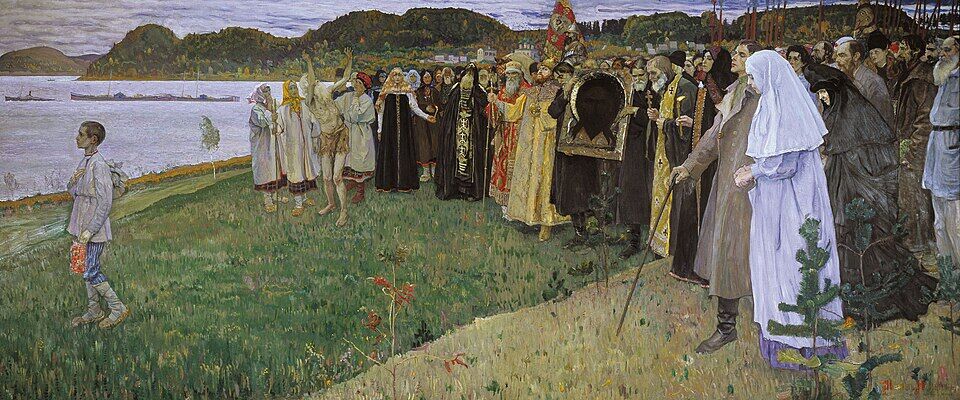
Nesterov painted the procession of a whole people along a river: peasants and soldiers, monks and a holy fool, figures in whom one can make out Dostoevsky and Tolstoy—and at the head of them all a sick boy leads the way. All of them are on the road, all are searching, and the horizon toward which they walk remains beyond the edge of the canvas. The painting was finished in 1916—on the eve of the collapse.
The 20th century answered the question "can one live without God?" not with reasoning, but with an experiment: godless utopias that promised heaven on earth and built camps. Here the Berdyaevian and Benjaminian critique of progress is fulfilled to the letter: a utopia that turns each present generation into material for the future is objectification on an industrial scale, man reduced to a unit, to a production quota, to a line on an execution list. And against this total objectification the witnesses rose up—those who chose to die rather than reduce themselves and another to a thing.
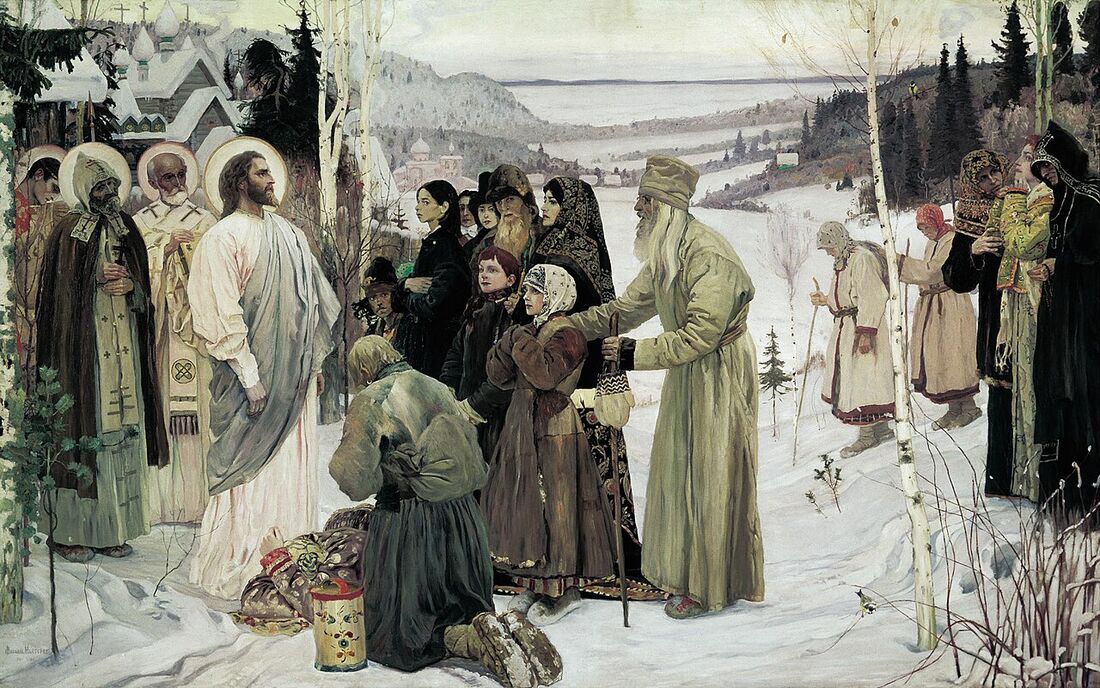
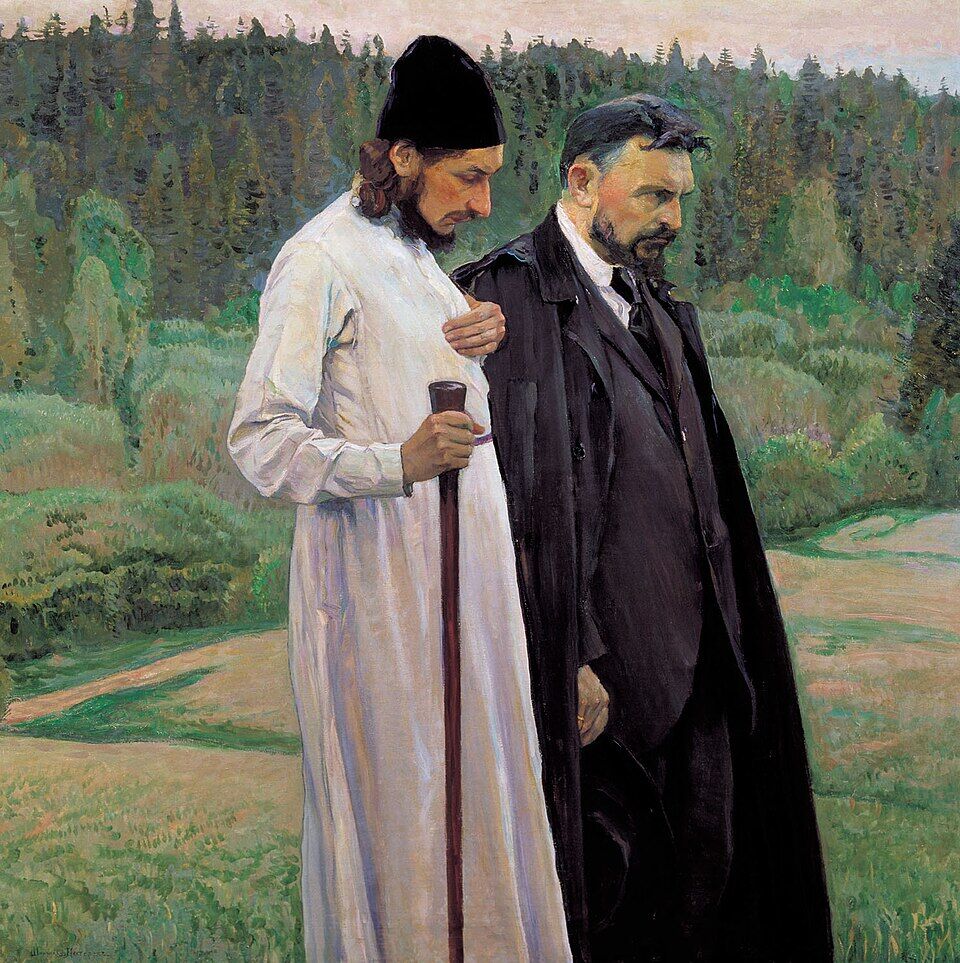
Here legal caution is needed: I speak only of history, without living actors. Among the new martyrs of the past century there are figures already indisputably historical. A theologian who wrote in prison of "religionless Christianity" and of how "before God and with God we live without God"—and who was executed for resisting tyranny. A prisoner of the camps who discovered there that "the line dividing good and evil runs through the heart of every human being"—not between classes and nations, as ideology insisted, but through every heart. This is testimony from within the very machine of depersonalization: the person is not reducible to a unit.
And here is the crux: the martyr does not prove God. The martyr shows what no argument can show—that in a human being there is something the state cannot reach, something that cannot be bought, broken, or objectified. And he calls this "something" not by the abstract word "dignity," but the Person, faithfulness to the Risen One. This is testimony, not proof; the answer is given not by an argument, but by a way of living and dying.
Here is the most delicate fork in the whole map, and the wall must be kept honestly.
As an archetype, the martyr is universal: the figure of integrity unto death—Socrates, Antigone, anyone who refuses to become an object even at the cost of life. "This is you yourself": you too may be set before a choice, and the inviolable core in you is real—regardless of whether God exists. The humanist has the right to claim the martyr entirely, as the highest proof of human dignity. And the humanist is not mistaken.
But there is a remainder that the martyr affirms and that humanism cannot take in without loss: the martyr says "I die for the Person who has risen," not "for the idea of dignity." In this remainder lies confession. It cannot be proved, only witnessed; and you, looking on from the side, remain free—the wall here is the same as Camus's, but quieter: you have the right to read the martyr as the glory of man or as the evidence of confession. The essay does not push you past the wall. It only keeps the question open—truly open—and notes one thing: in the bloodiest of centuries the question "can one live without God?" received an answer from people who lived and died as if the answer were a Face.
What to carry away from here is this very openness. Do not mistake the death of an idol for the death of God; but neither mistake a surviving ethics for a surviving faith. The honest position stands together with the monk before the sea—and looks upon the witnesses who answered without words.
The Eschaton
return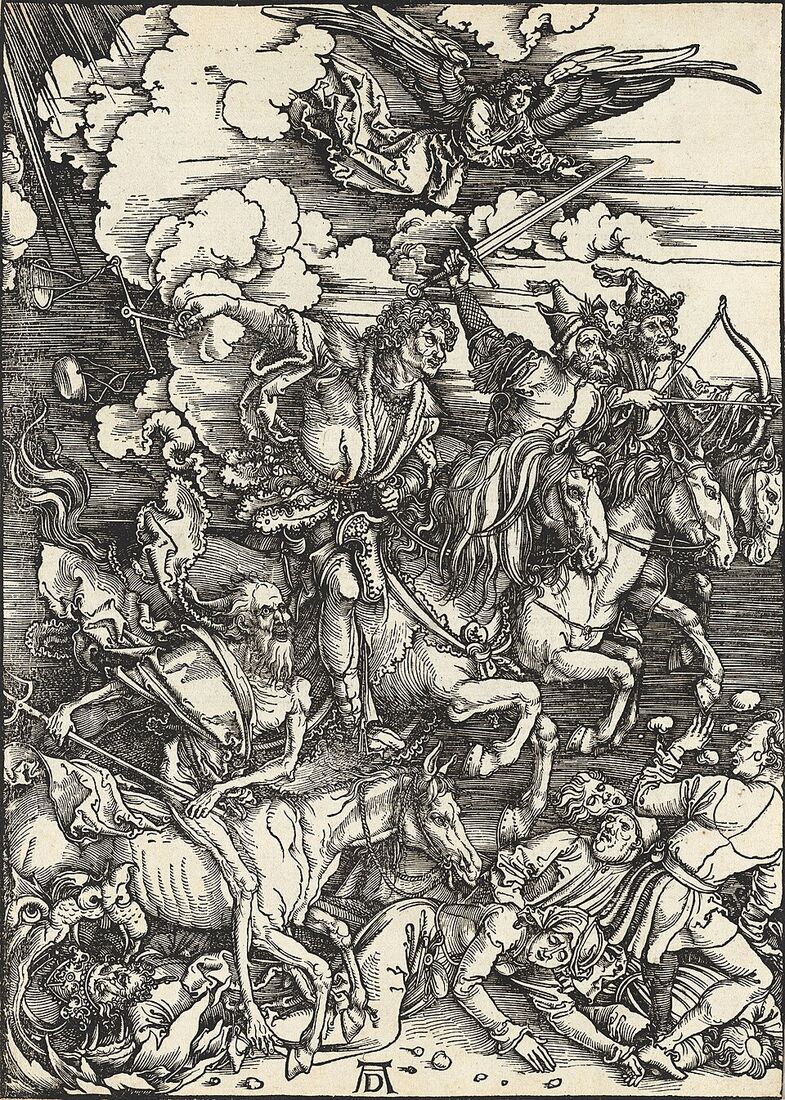
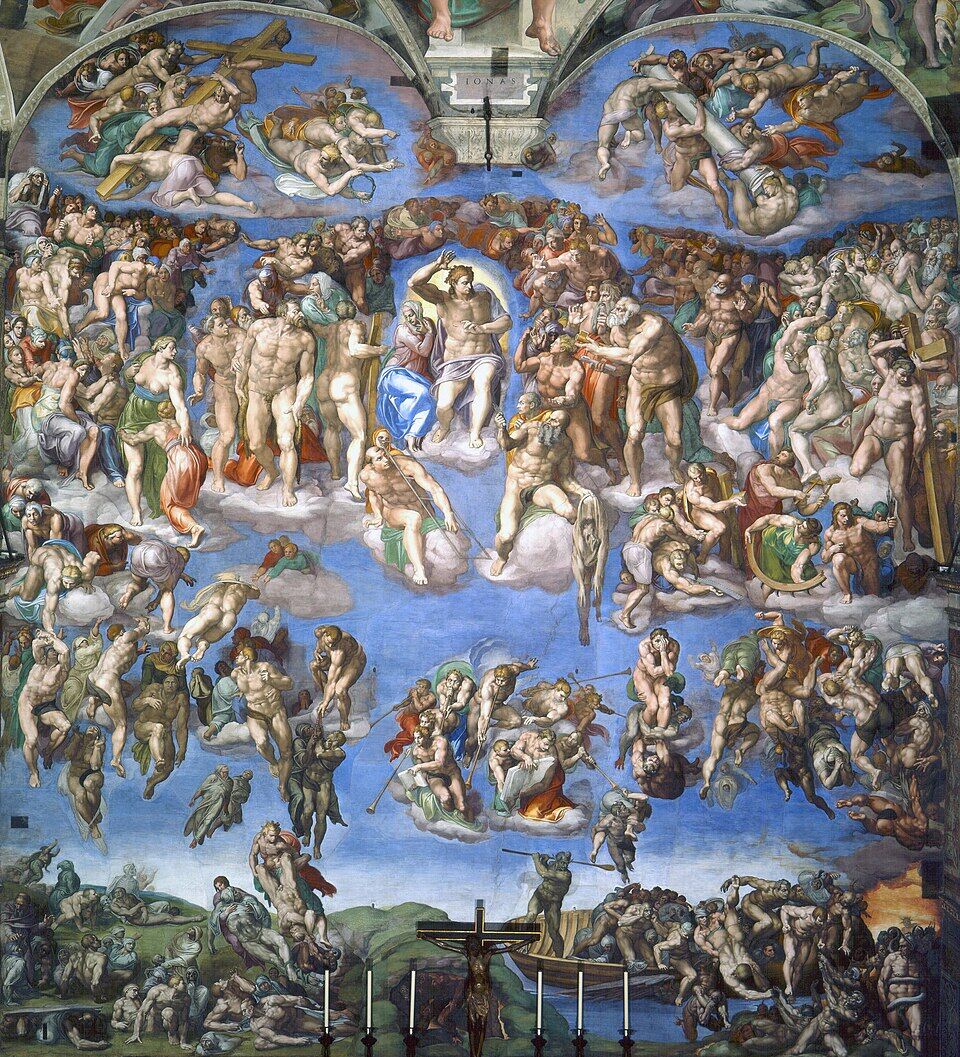
Walter Benjamin left behind an image that holds this question better than any treatise — the Angel of History. Looking at Klee's watercolor "Angelus Novus," he saw an angel turned to face the past. Where we see a chain of events, the angel sees one single catastrophe, tirelessly piling wreckage at his feet. He would like to pause, to raise the dead, to gather what has been shattered — but a storm blows from paradise, it beats against his wings, and he cannot fold them; the storm irresistibly bears him into the future, to which his back is turned. "That which we call progress is this storm."
Thus secular eschatology is unmasked. Progress is not redemption but a storm; the future is bought with the wreckage of the present. This is precisely the Berdyaevan thought with which the whole map began: progress turns every generation into a means, sacrifices the living of today for a radiant tomorrow. History without an end lying beyond its limits is a meaningless circling; only in eternity are human destinies resolved. Thus the question of the telos is universal and ineradicable. One question remains: what the end is.
Dürer carved the end as a thunder: four horsemen — conquest, war, famine, and death on a pale horse — race across heaps of bodies, and even the emperor is flung beneath the hooves. This is the end-as-horror, the very wreckage the angel sees, the apocalypse-as-disaster as the popular imagination paints it. But the word "apocalypse" (ἀποκάλυψις) itself does not mean "catastrophe." It means "the lifting of the veil," revelation. The horsemen are not the meaning of the end; they are the tearing of the curtain. Beneath the catastrophe the image seeks not ruin, but that which is laid bare when the scenery burns away.
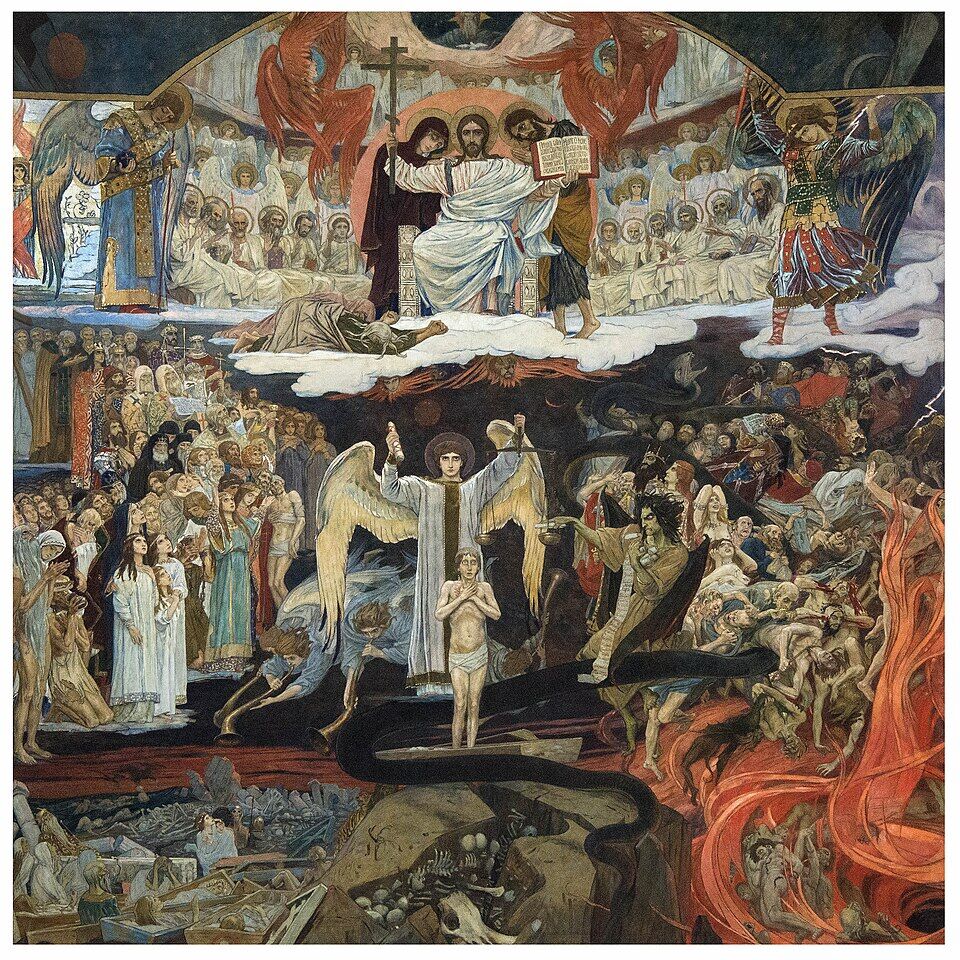
Vasnetsov painted the Judgment across the whole span of the cathedral wall: an angel with scales, the hosts of souls, the Judge in glory. The fear of Judgment is the fear of being at last seen, known to the end, the fear of the objectifying gaze that will reduce you to your worst deed, to a line in a file. But here is the overturning. The Judge is the One who was crucified; the Judge bears the wounds (that same Risen One at point-blank range in Piero). And then Judgment proves to be not objectification — not a reduction to a dossier — but its opposite: to be seen to the end by Love and not annihilated. The last defeat of objecthood: in the end you are not a case, not a unit, not a production quota — you are a face, beheld by a Face.
And then the end is a meeting. "And God will wipe away every tear from their eyes, and death shall be no more; neither shall there be mourning, nor crying, nor pain anymore." The end of the world of objects: there is no more death — and death was the last triumph of objecthood — there are no more tears. The wreckage over which Benjamin's angel grieves, the believer confesses gathered: the dead are raised, the shattered made whole — precisely what the angel wished to accomplish but was denied by the storm. The Eschaton is the storm reversed: not a progress that bears us backward over the wreckage, but a Face coming to meet us and taking the wreckage up into resurrection.
The Berdyaevan thread here closes with the beginning: the meaning of history is not within history but at its edge, where eternity breaks through time. The Eschaton is the completed breakthrough.
Here again runs the boundary of archetype and confession, but more gently than at the empty tomb.
As an archetype, the longing for a meaningful end — for justice, for the wiped-away tear, for redeemed wreckage — is universal. "Here is you yourself": this every heart desires; the atheist Benjamin, grieving over the wreckage, thirsts for it no less than any saint. The hope that history is not a meaningless storm is the most human of hopes.
But behind the hope there is a confession: not merely "would that the tears were wiped away," but "and God will wipe away every tear" — a promise bound to a Person who comes. Why is this wall quieter than the Resurrection wall? Because here the universal longing and the confession almost touch: the wiped-away tear is what everyone awaits; the believer only confesses Who wipes it and what He has already begun — for the Risen One is the firstfruits. The wall is gentler because hope and faith here are neighbors; the line runs between "so let it be" and "so it will be, and His Name is —." The essay does not push you beyond the wall; it only observes that no one escapes eschatology, and asks which one you live by: the storm — or the meeting.
Here the map closes upon itself. The pre-worldly freedom to say "yes" or "no" (Essay No. 1) — the Face at the empty tomb (No. 2) — the Body enduring through time (No. 3) — the open question and the witnesses (No. 4) — the end as a meeting (No. 5). The last "yes/no" is the greatest: it is no longer about a single tomb, but about the telos of the whole. The drama has brought you to the final wall — the quietest. Beyond it lies either the storm or the Face. Beyond that — you.